
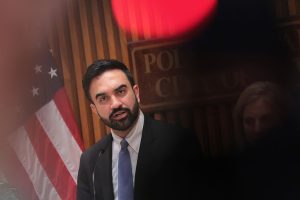
Since taking office earlier this year, New York City Mayor Zohran Mamdani has made good on his dangerous campaign promises to reaffirm Gotham as a “sanctuary” city and thwart the efforts of federal authorities to arrest and deport criminal illegal aliens. While Mamdani’s pro-open borders policies have gotten plenty of attention, perhaps his most haunting comment that went largely unnoticed is the suggestion that we should look to Islam as an example of how to treat migrants – legal or illegal.
Many liberal New Yorkers and Americans are still hoodwinked by Mamdani’s soft-pedaling of radical anti-Western ideology. But when you are a Middle Eastern Christian immigrant like me who is familiar with this communist-Islamist worldview, you understand that people like Mamdani are neither novel nor exciting. They are everything we ran away from.
The regime that was in power when my family left Iraq was the anti-colonial national socialist Ba’athi Party. As a child in school in Baghdad, part of my education was the Ba’athi propaganda of unity, freedom, and socialism. (Sound familiar, New York?) The Middle East after World War II was a hotbed for a communist-flavored Arab nationalism. Of course, there was the Muslim Brotherhood as well and their desire for a radical Islamist Middle East.
I’m painting in broad strokes, but one can think of the Middle East after World War II as a major arena in which the United States was attempting to push back the influence of the Soviets. This was a difficult task since there was a great deal of anti-Western sentiment in the region. For us in Iraq, after the July Revolution of 1958 dissolved the monarchy, we had several other revolutions until Saddam Hussein assumed power.
My parents come from the generation which still remembers life under the British-backed monarchy of King Faisal II. I came to America when I was nine but was raised in an Iraqi Christian subculture in California. Discussion of Middle Eastern history and politics was part of that subculture. One of the issues that was always debated was the Palestinian cause and what should have been done or not done. It was controversial even in Christian circles. One issue, however, was never controversial among the diaspora – the belief that Islamists will never stop in their quest for total domination.
I dismissed the fears of the diaspora as the PTSD of people who had been under the thumb of Islamists or authoritarians for too long. This was America, after all. These things can’t happen here, right?
I attended public school and grew up at a time when America still had a solid Christian identity, self-confidence, and a republican understanding of herself as a nation. America knew it was not perfect, but it knew that it was good. I had wonderful public school teachers that taught me the English language without apology; American history without self-immolation; and patriotism without self-hatred. Not everyone I met was Christian, but there was a cohesion into which I was able to assimilate.
I grew up, married an American man, had children, and became a writer. As I read, thought, and wrote about American culture, religion, and immigration issues, I became aware of small movements within immigrant subgroups that raised red flags for me.
Since Hamas attacked Israel on October 7, 2023, the West has been flooded with pro-Palestinian propaganda. Jews have been killed, assaulted, and harassed throughout America. New York’s anti-Semitic movement has been particularly unrelenting.
Middle Eastern Christian immigrants are not a substantial enough group to draw that kind of hate. Besides, Islamists have either killed or cowed us into submission in the Middle East already – to them we are already conquered.
The Christians that come here build their communities around their churches, family, and friends. If you couple that with the freedoms enjoyed in this country, it helps to insulate them from the abuse and prejudices they experienced in their countries of origin.
However, this tiny minority – especially those of us who have been here for many years – have had our eyes on the rise of political Islamists like Mamdani, Ilhan Omar in Minnesota, and Rashida Tlaib in Michigan in our adoptive country.
For my parents and many others like them, these figures carry with them the memory of the machinations, prejudices, and hatred they experienced in their country of birth. For Middle Eastern Christians, the rise of Mamdani with the backing of an activist like Linda Sarsour and the Council on American-Islamic Relations is significant.
In an episode of “Interesting Times” last year, New York Times columnist Ross Douthat said that Mamdani’s victory is less significant than many think. He specifically states that it won’t save the Democrats nationally since one cannot map New York City politics onto the rest of the nation. He also recounted the history of Big Apple mayors and how they failed to springboard onto the national stage from the mayoral plank.
That is a very myopic view of Zohran Mamdani, his politics, the intentions of those who helped him to power, and the Islamist movement behind it all.
Last September, a Dearborn, Michigan city council meeting made news across the country. A Christian resident, Ted Barham, brought up his concerns about renaming a city street after Osama Siblani, the radical editor of Arab American News. In response, the mayor of Dearborn, Abdullah Hammoud, called Mr. Barham an Islamophobe, and said: “Although you live here, I want you to know as mayor, you are not welcome here. The day you move out of the city will be the day I launch a parade celebrating the fact that you moved out of the city.” Mr. Hammoud was re-elected that November.
Middle Eastern Christian immigrants are not surprised at all at this behavior since many experienced these prejudices in our country of origin, and they were part of the reason so many emigrated out in the first place – we did not want to live under the authoritarian rule of Islamists.
What has surprised me (but not people from my father’s generation) is that this radical Islamist sentiment has been allowed to take root and grow to this extent in America.
There is a video of Islamic activist and Mamdani mentor Linda Sarsour, unabashedly saying that it was “Muslim money” and the Muslim community that helped Mamdani “ascend to this place.” She and others in her group plan on holding him accountable if he doesn’t follow through with their mandate, specifically disbanding the NYPD task force that polices riots, protests, terrorist threats, and the like. The disbanding of this unit is key to the pro-Palestinian movement.
On election night, there was a video of an Islamist shouting in the streets of New York, “we will not stop until it [Islam] enters every home.”
Imagine moving to another city or country to get away from a bully that daily makes your life miserable only to wake up one day and find that the bully has followed you to the new city or country. That is what it feels like for Middle Eastern Christians when Islamists follow them to America and then gain political power.
Of course, not all Muslims, or even Muslim migrants, hold the view that Mamdani and his ilk promulgate. I have met many Muslims who love America and wish to coexist peacefully with Christians and Jews.
But this does not erase the threat of political Islamists who have money and backing. They want to set up cities under Sharia law, effectively replacing the Constitution. Their mission is to make sure Islam “enters every home” – whether willingly or by force. They want nothing less than to turn America into an Islamist theocracy like Iran.
Liberal arguments aimed at assuaging people’s anxieties may be well intended, but they blunt critical thinking on these issues. It’s time for a more focused lens – one that specifically considers the aims of Islamists using our democratic system to destroy American culture and erode the American way of life.
Luma Simms is an AMAC Newsline contributor.
