
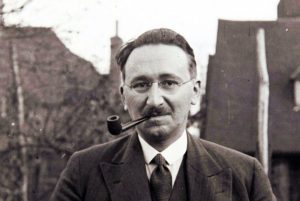
Once in a while, looking back at great minds awakens new understandings. We could say that about philosophy, politics, physics, Aristotle, Plato, Newton, Einstein, and our Founding Fathers. We seldom say it about economists, yet some greats exist. One is the late Friedrich Hayek.
So, what makes Hayek so great? Maybe just that he validated our common sense, arguing in his book “The Road to Serfdom” (1944) that concentrated power is always a bad thing, whether you call it socialism, communism, fascism, progressivism, or just plain “central planning.”
As America has another moment of brainless belief in utopian ideas like using coercion to force people to do things they do not want to do, from buying high-cost energy and ignoring borders to legalizing dangerous drugs and turning boys into girls, Hayek’s economic arguments pop to mind.
Years ago, studying economics, several thinkers – all about limited government – appealed to me. Way back, you had Adam Smith and his “invisible hand.” In the late 1700s, while we were fighting for political freedom, he wrote about economic freedom.
His idea was this: Letting millions of people decide for themselves what they wanted to spend their earned money on would lead to a better balance between demand for things and supply of them than having the pointy-headed government folks try to figure out the right balance.
In his book, “The Theory of Moral Sentiments,” Adam Smith argued that people know best their own interests and values, and if that is so, then government will fail in getting closer to them than we do. In “Wealth of Nations,” Smith argued letting people make economic decisions for themselves was best for a society – less government created more prosperity, based on that “invisible hand.”
Wind the clock ahead to this somewhat forgotten economist named Friedrich Hayek, and you get an extension of the Adam Smith thinking. Hayek thought that any time you get concentrated government over a certain amount, over the “safety net” amount, bad things begin to happen.
In his “Road to Serfdom” book, he told readers to be on guard, since “tyranny … inevitably results from government control of economic decision-making through central planning.” The way to preserve economic – and political – freedom is less government, more focus on preserving individual decision making, at every level and about everything.
Hayek worried – seeing comparable evil in centralized planning by communism and fascism – that America would forget that centralized government comes slowly, but can be devastating to individual liberties, which are hard to regain once lost.
He said free countries had already begun to “progressively abandon” the kind of “freedom in economic affairs … without which personal and political freedom has never existed in the past.” In other words, even back then, he worried that we were sacrificing personal freedoms for government control, and he said – Do not do it.
He was so concerned about the future, and reminding people to protect their ability to make economic decisions for themselves – not let government take that power away – he said if the drift continues, it inevitably ends in “totalitarianism,” total loss of freedom.
In simple terms, he thought “centralized planning” was using the mighty power of the state to force people to do what the state wanted – by “coercion” – and that kind of overregulation not only hurt prosperity, but undercut the goodness of free markets.
He would hate what he sees in “progressive” or Democrat controlled states in America today, as he would recognize it as overregulation, coercive, forced compliance with their centralized planning, “the will of a small minority being imposed upon people,” first eroding and then ending the rule of law and individual liberty.
He would recognize falsehoods put out by Democrat-controlled, pro-government states like California, Minnesota, and Maine as “propaganda” meant to deceive, deny, and distract from efforts to further consolidate power, creating more “bigness.”
He believed that wealth creation was good, that free societies invited it while centrally planned ones killed it, and that the goal of aiming “to improve the general level of wealth” was a vital assurance of human progress, the opposite a threat to it.
He also saw massive, publicly funded “international organizations” as a threat to individual liberty, and in an application of Adam Smith’s “Invisible Hand,” a threat to prosperous, freely deciding citizens of advancing economies.
If limited government had a role in keeping people safe, competition open, and individual liberties secure, it was also a threat once it began to grow. So influential was Hayek that Winston Churchill, Ronald Reagan, Milton Friedman, and many modern conservatives credit him – a Nobel Prize winner – with setting a new high bar.
What does it all mean today? Just this. Great minds of the past justify a staunch defense of individual political – and economic – liberties, and that is a timeless battle.
Robert Charles is a former Assistant Secretary of State under Colin Powell, former Reagan and Bush 41 White House staffer, Maine attorney, ten-year naval intelligence officer (USNR), and 25-year businessman. He wrote “Narcotics and Terrorism” (2003), “Eagles and Evergreens” (North Country Press, 2018), and “Cherish America: Stories of Courage, Character, and Kindness” (Tower Publishing, 2024). He is the National Spokesman for AMAC. Today, he is running to be Maine’s next Governor (please visit BobbyforMaine.com to learn more)!
