
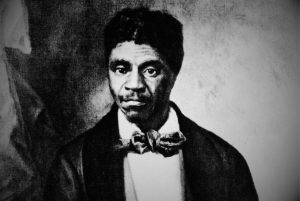
On March 6, 1857 – 169 years ago today – the United States confronted one of the most consequential and troubling Supreme Court rulings in its history in Dred Scott v. Sandford. But while this decision was a dark moment in America’s past, it nonetheless ultimately revealed America’s exceptional character through the public reaction to it.
The court’s opinion in Dred Scott infamously stated that enslaved people were not citizens and therefore possessed “no rights which the white man is bound to respect” – including the right to sue in federal court. It was authored by Chief Justice Roger B. Taney – a Democrat appointed by Democrat President Andrew Jackson.
For pro-slavery advocates, Dred Scott was supposed to be the final settlement of the slavery question. But instead, the ruling exposed the deep moral and constitutional fissures threatening the nation’s future. It awakened a broad swath of Americans to the urgent need to align the nation’s laws with its founding promise that all are created equal with intrinsic dignity.
By the mid-1850s, the country was reeling from the fallout of the Kansas-Nebraska Act, the collapse of the Whig Party, and violent clashes in “Bleeding Kansas.” Into this volatile moment stepped Dred Scott, an enslaved man who had lived for years in the free territories of Illinois and Wisconsin with his owner before returning to the slave state of Missouri.
After Scott’s owner died in 1846, Scott sued for his freedom, appealing to the long-standing doctrine of “once free, always free.” But Chief Justice Taney’s opinion went far beyond Scott’s personal claim. It struck down the Missouri Compromise, denied Congress the authority to restrict slavery in the territories, and attempted to freeze the Constitution in the 1780s. Even some who supported slavery were startled by the breadth of the Court’s assertion of judicial power.
The ruling ignited a national outcry. Abolitionists condemned it as a betrayal of the Declaration’s ideals. Frederick Douglass denounced the decision as a “scandalous tissue of lies,” yet he also predicted that its extremity would awaken the nation’s conscience.
Newspapers across the North warned that the Court had effectively nationalized slavery, making freedom the exception rather than the norm. The decision clarified the stakes for a young political movement committed to halting slavery’s expansion and preserving the territories as free soil.
Abraham Lincoln emerged as one of the most incisive critics of the ruling. He argued that the founders had tolerated slavery as a temporary evil, not a permanent national institution, and that Taney’s opinion distorted both the Constitution and the nation’s moral compass. Lincoln warned that if the Court’s logic were accepted, no state could remain free. His debates with Stephen Douglas in 1858 brought these issues to the forefront of national life and helped shape the election of 1860.
The Lincoln-Douglas debates remind us that the most consequential questions in American life have always turned on the same hinge: whether human dignity is inherent or conditional.
In 1858, the nation argued openly about whether an entire class of people could be reduced to utility – valued for labor, economics, or political advantage. Today, our debates unfold not in three-hour public arguments like the Lincoln-Douglas debates but in fragmented social-media bursts that often obscure the deeper question of whether any human life may be treated as contingent, negotiable, or disposable. The particulars differ across the eras, but the underlying struggle is the same. A society that forgets the intrinsic worth of the person inevitably drifts toward treating people as instruments rather than individuals created in the image of God.
The Dred Scott decision did more than inflame public opinion – it set the stage for the constitutional transformation that followed the Civil War. The very overreach of the Court in 1857 created the moral and political momentum that empowered the Radical Republicans a decade later. Their historic action on March 2, 1867, of overriding Andrew Johnson’s veto of the First Reconstruction Act was the direct constitutional answer to the injustice of Dred Scott.
Where Taney denied citizenship, the Radical Republicans would secure it through the Fourteenth Amendment. Where the Court had sought to silence the national conscience, Reconstruction sought to restore it.
Together, the two anniversaries – the Court’s Dred Scott decision and the Radical Republicans’ override of Johnson’s veto – form a single arc from the Court’s denial of human dignity in 1857 to Congress’s bold effort to rebuild a nation on firmer moral and constitutional ground in 1867.
Dred Scott exposes the peril that arises whenever law is severed from a fixed moral horizon. The human person becomes negotiable, dignity becomes conditional, and power fills the vacuum where principle once stood.
Dred Scott also, however, stands as evidence of the American capacity for renewal. Schoolchildren today learn that the decision was one of the worst in American history, and rightly so. But we ought to also be teaching them that Dred Scott reveals America’s exceptional character because of the outcry against it.
That public outcry helped prepare the nation for a profound transformation – the Civil War, the Emancipation Proclamation, and the Reconstruction amendments that abolished slavery, established birthright citizenship, and guaranteed equal protection under the law. It is a reminder that the Spirit of 1776 and the promises of the Declaration are ultimately safeguarded not in a courtroom but in the hearts and souls of the American people.
As we mark this anniversary, we remember the courage of those who were stirred to action by injustice. Their perseverance helped bend the nation toward a more faithful expression of its creed – that all are created equal and “endowed by their Creator with certain inalienable rights, and that among these are life, liberty, and the pursuit of happiness.”
Phill Kline is a former state legislator and the former Attorney General of Kansas. He is currently a law professor.
