
America’s greatness has never come from the halls of Congress or the windowless offices of federal agencies. The greatness of America is found in persons exercising freedom with responsibility. It lives around our kitchen tables, in our places of worship, and in the community halls where families shape dreams and neighbors gather to overcome challenges.
Washington may dominate the headlines, but it is ordinary Americans who keep the country standing.
On this very day — May 29, 1790 — the smallest and most stubborn of the original thirteen colonies proved that truth in dramatic fashion. After rejecting the U.S. Constitution seven times, tiny Rhode Island delegates gathered for a final time to consider ratification.
Technically, only nine colonies needed to ratify the Constitution for it to go into effect. But the United States had just fought a war against the most powerful empire on the planet to become one country. Had all 13 colonies not been able to agree, it would have vindicated the prevailing belief in Europe that the Americans were incapable of governing themselves – and perhaps sowed the seeds of destruction for the fledging nation.
Rhode Island ultimately ratified it by the slimmest of margins: 34 to 32. No armies marched on Providence. No king compelled obedience.
Ordinary citizens – farmers, merchants, pastors, all delegates chosen in town meetings, shaped by local churches and family discussions — debated fiercely, weighing their fears about centralized power.
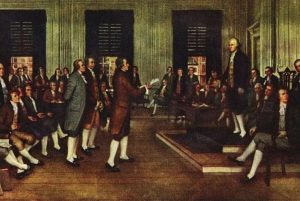
The final day’s session had moved from the Colony House in Newport to the larger Second Baptist Church, whose galleries overflowed with townspeople anxious for the outcome. Delegates sat in the plain wooden meeting hall as the late afternoon light fell through tall windows, the air thick with uncertainty.
The vote was so close that no one knew the result until the roll call ended at 5:20 pm. When the tally in favor of ratification with the inclusion of the Bill of Rights was announced, church bells across the colony began a chorus of celebration.
It was the final, voluntary act that unified the United States under the Constitution. This was something unique in history – free citizens voluntarily entering into a political compact without the pressure of an army or king.
We forget this because our national imagination has been captured by spectacle. We measure power by who trends on social media, who shouts the loudest on cable news, or who controls the levers of bureaucracy. But the real strength of the republic has always been quieter; and it is far more durable.
It is the mother who works two jobs and still finds time to help her child with homework. It is the pastor who visits the sick at 10 p.m. after a full day of ministry. It is the volunteer firefighter who leaves dinner to answer a call. It is the retiree who tutors children at the local library. It is the small-business owner who sponsors the Little League team because someone needs to.
The greatness of our nation is and always has been a citizenry that knows there is a good, and which seeks that good, while seeking to be good. As Tocqueville observed, America is good because its people are good.
These are the people who hold the country together. They do not seek attention. They do not demand applause. They simply live out the virtues that make self-government possible: responsibility, sacrifice, fidelity, and hope.
The Founders understood this. They believed that the success of the American experiment depended not on the brilliance of its institutions but on the character of its citizens. A free people must be a formed people. Liberty requires self-restraint. Community requires commitment. Democracy requires neighbors who still believe in the common good.
Today we are told America is hopelessly divided. But if you step outside the noise, you will find something different. You will find parents coaching youth sports together. You will find congregations feeding the hungry. You will find civic clubs raising money for families in crisis. You will find people who disagree politically but still shovel each other’s driveways after a snowstorm.
These quiet Americans are not naïve. They know the country is struggling. They see the dysfunction in Washington. They feel the weight of cultural fragmentation. But they have not surrendered to despair. They still believe in the promise of this nation because they still believe in the dignity of the person — the idea that every human being is created with purpose, endowed with agency, and capable of contributing to the common good.
This is the American genius – not the machinery of government, but the moral imagination of ordinary people.
If America is to be renewed, it will not begin in Congress. It will begin in the places where Americans still gather to pray, to serve, to teach, to build, to comfort, and to dream. Renewal will come from the bottom up — from the quiet Americans who have always been the true custodians of the republic.
Washington may write the laws, but the people write the story. And the story is not finished.
Phill Kline is a former state legislator and the former Attorney General of Kansas. He is currently a law professor.
