
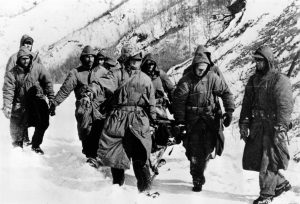
There are moments in American history when the character of a nation is revealed not in its victories, but in its refusals – its refusal to abandon, to forget, to leave its own behind. One of these moments came in the winter of 1950, at a frozen corner of the world called the Chosin Reservoir.
The 1st Marine Division, roughly 25,000 Marines and attached personnel, was surrounded by 120,000 Chinese troops in temperatures that plunged to 40 degrees below zero. Frostbite claimed fingers and exposure claimed lives before the enemy could. Weapons jammed. Engines froze. The wounded lay on stretchers that turned rigid with ice.
Every rational calculation said the Marines should move fast and light, leaving behind everything that slowed them down – including their dying comrades. They refused.
They lashed their wounded to trucks, tanks, and makeshift sleds. They carried their dead out with them. They fought their way through a gauntlet of fire not simply to survive, but to ensure that no Marine – living or dead – was left in the hands of the enemy. “Retreat, hell,” General O.P. Smith said. “We’re just attacking in another direction.”
Chosin was not a battle. It was a declaration of identity. It told the world who we were. And it still does.
As we approach Memorial Day, this column is focusing on the cost of remembrance. America is exceptional because we have long been a people who understand the weight and the significance of a single life.
Our government is formed on the self-evident truth that each and every human being has intrinsic value because God Almighty placed that value within each person at the moment of creation. In such a nation, the loss of one son, one Marine, one airman, is a matter worthy of national pause.
Which brings us to the present.
A few weeks ago, when an American F-15E Strike Eagle was shot down inside Iran, the United States did what it has always done: We went after our own.
The pilot was recovered quickly. His weapons systems officer, a colonel, evaded Iranian forces for nearly 48 hours in the Zagros Mountains – alone, injured, hunted.
What followed was one of the most complex special operations rescues in American history. ISR platforms, strike aircraft, helicopters, and ground teams coordinated across hostile territory to bring two Americans home.
They did this knowing the risks because they still believed in that central tenet of American Exceptionalism that every life is worth it. They had faith that their belief in and commitment to one another would win the day.
This is the same faith that carried the Marines out of the Chosin with their wounded and their dead. It is the instinct that sent Rangers into Mogadishu, SEALs into Abbottabad, and rescue teams deep into Iranian territory.
That instinct is foundational for a free society. A nation dedicated to individual liberty cannot treat human beings as expendable or interchangeable.
When America stands firm on this unbroken strand of moral fiber, when its actions match its founding words, American influence is at its greatest, and the world is better for it.
This moral clarity stands in stark contrast to the moments when political expediency eclipsed principle. We saw it in the hasty abandonment of Kabul, where the rush to meet the anniversary date of 9/11 became more important than the duty to bring our people home.
The troops on the ground, as always, served with distinction. But 13 Americans died in that botched evacuation, and countless allies were left behind because the timeline served politics, not prudence.
We saw it in Vietnam, where declassified documents now confirm what many suspected for decades: evidence of men left behind was brushed aside so leaders could claim “peace with honor” and close the book on a war that had become politically burdensome.
These are not failures of capability or of the brave military personnel in harm’s way. They are failures of leadership – failures in patience, courage, and moral endurance.
Too often, it is the heroes on the ground who show the courage and bravery that should be exhibited by their superiors, but is not.
On May 5, 1945, during a fierce battle on Okinawa in the South Pacific, Army Corporal Desmond Doss climbed the Maeda Escarpment, a 500-foot cliff held by Japanese forces, and dug into a fortified network of caves and tunnels. Elements of the 96th Infantry Division had reached the top but were driven back by machine-gun fire, mortars, and concealed positions that inflicted heavy casualties.
When the line broke, and the uninjured retreated back down the ropes, Doss remained on the ridge. As long as one injured man remained, Doss prayed for the strength to save “just one more.”
Unarmed and alone for nearly 12 hours, Doss moved among the wounded, bandaging injuries and carrying men to the cliff’s edge. One by one, he lowered them down the face of the escarpment using a rope sling he tied to himself. Doss lowered 75 men to safety. Only then did Desmond Doss follow them.
On May 2, 1968, Master Sergeant Roy Benavidez boarded a helicopter without orders, carrying only a medical pack, and later descended into a Vietnamese jungle. There he ran, crawled, and fought his way through a withering kill zone to reach the wounded. Benavidez was shot, stabbed, and hit by shrapnel, but he continued to pull wounded Americans out of a hopeless firefight. He went back again and again, refusing evacuation, refusing to quit, refusing to leave his brothers behind. Benavidez returned with 37 wounds.
The men who bring others home do so without celebrity, unguided by polling, absent cameras and microphones, but propelled by a courage emanating from a faith that doing one’s duty in the present preserves a hope for tomorrow.
Our present danger is that we allow ourselves to become immersed in a political performance culture, where leaders chase headlines rather than results. Here, the appeasement of immediate preferences defeats the substance of duty. And here, decisions are driven by polling crosstabs rather than the obligation to preserve blessings for the next generation.
We must demand more of our leaders. But to do so, we must demand more from ourselves. As Proverbs reminds us, “Where there is no vision, the people perish.”A nation that can only see today will fail tomorrow.
Such a culture sells sacrifice cheaply and buys immediate relevance at any price. Media outlets, commodifying clicks through faux outrage rather than providing information, have siloed the American political voice into a gaggle of isolated grievances – grievances recycled into clicks and converted into wealth.
If we descend into this narcissistic information silo, promoting the cycle of grievance, outrage, victimhood, demand, and exploitation of the moment, commonality and vision become the enemy and not the objective. When leadership lacks vision, it is because the people lack vision.
Vision – the courage to consider tomorrow in the decisions of today – dies when we do not have faith in the goodness of a God who holds tomorrow in His hands.
But it also means such courage lives where faith lives. And so, a wounded colonel hundreds of miles behind enemy lines in Iran, hunted by determined ground forces and isolated from his brothers and sisters, struggled his way up a mountain into a crevice and sent a message to those seeking him: “God is good.”
Such faith gifts the courage to step into the present and bring the one who is lost home. For He is the one who leaves the 99 to find the one.
Phill Kline is a former state legislator and the former Attorney General of Kansas. He is currently a law professor.
