
History is crowded with nations formed to control populations, to consolidate wealth and power, and to serve the interests of the strong. Tested before and challenged still, America endures apart from them because it is a nation conceived in liberty, with its government intentionally designed to protect the rights of every individual from the tyranny of a few.
It was for this idea – this fragile and audacious dream – that on May 1, 1943, a small-statured staff sergeant named Maynard “Snuffy” Smith took his position as a waist gunner aboard a B-17 Flying Fortress for his very first combat mission over enemy-held Europe.
Maynard Harrison Smith was born in 1911 in Caro, Michigan. He was no one’s idea of a model soldier. Short in stature but long on attitude, Smith earned the nickname “Snuffy” after a comic strip character known for being something of a screw-up. Yet when duty called, he answered, joining the Army Air Forces during World War II.
Assigned to the 306th Bomb Group, 423rd Bombardment Squadron, Smith served in one of the most dangerous roles in the air war. On May 1, 1943, his B-17 with its 10 crew members joined a mission targeting German U-boat pens at Saint-Nazaire, France – a place bomber crews grimly called “Flak City.”
The bombing run succeeded, but on the return flight, disaster struck. The aircraft was hammered by anti-aircraft fire so dense it looked like the plane was flying through black steel wool. Cannon shells from attacking fighters ripped open the fuselage. Flames roared through the radio room and waist section, turning the aluminum skin into a glowing furnace. The oxygen system was shredded. Control cables hung like snapped tendons. Wounded crewmen lay bleeding on the floor as the bomber bucked under repeated hits. Three airmen, believing the plane doomed, bailed out over the Channel and were never seen again.
What happened next was extraordinary. Pilot Lewis Johnson, co-pilot Robert McCallum, and navigator Stanley Kissenberth willed the crippled plane back towards England.
Staff Sergeant Smith and three seriously injured crewmen were alone in the middle of the fuselage, which was becoming engulfed in flames. Smith refused to give up. He fought the spreading fire with extinguishers until they were empty, then beat back the flames with his hands, his jacket, and anything he could grab. Ammunition cooked off around him like exploding popcorn. He hurled burning rounds out of the gaping holes in the fuselage to keep the plane from detonating. Between bursts of firefighting, he manned the waist guns, firing at enemy fighters that swarmed like hornets around the crippled bomber. He tended to the wounded tail gunner, dragging him away from the flames and administering first aid as the aircraft shuddered under fresh attacks.
For nearly ninety minutes, Smith waged a one-man war against fire, exploding ordnance, and the Luftwaffe. Thanks to his courage and ingenuity, the battered B-17 made it back to England. It had taken more than 3,500 hits. But six crew members were alive because one determined airman would not quit.
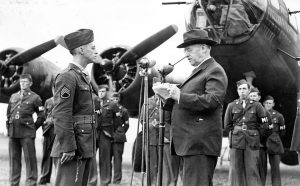
For his actions that day, Maynard “Snuffy” Smith became the first enlisted man in the U.S. Army Air Forces to receive the Medal of Honor. Secretary of War Henry Stimson pinned it on his chest.
After the war, Smith returned to Michigan. His life, like that of many veterans, was complicated. He worked a series of jobs, struggled at times with the weight of his experiences, and lived far from the spotlight. Yet he remained a symbol of the ordinary American who, when history demanded it, rose to an impossible moment with selfless resolve.
Snuffy Smith was not a famous general or a celebrated pilot. He was someone who met fire with courage and chaos with resolve. His generation handed us a free nation purchased with such extraordinary ordinary bravery. Whether we keep it depends on whether we are still willing to answer the call when it comes, even on our very first day in the fight.
The strength of a nation is not measured only in its institutions or its declarations, but in the character of its people. America endures because men like Snuffy Smith refused to surrender when the sky itself seemed to be falling. They fought through smoke and fear and impossible odds so that freedom might live another day.
We inherit that legacy. And in our own time – amid uncertainty, division, and the steady drumbeat of cynicism – we are called to remember what they proved: that courage is contagious, that duty is noble, and that a single determined soul can hold the line long enough to land the plane.
American exceptionalism is not an abstract idea. It is the lived testimony of citizens who choose sacrifice over comfort and resolve over despair. Snuffy Smith was one of them. May we be worthy of the freedom he fought to preserve.
Phill Kline is a former state legislator and the former Attorney General of Kansas. He is currently a law professor.
