
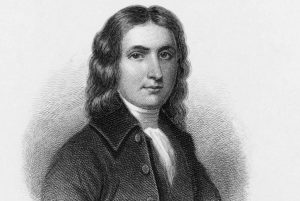
One of the most sinister lies being taught in many American schools today is that the American Revolution was not a righteous crusade to uphold God-given rights, but rather a conflict driven by greed and precipitated by wealthy men to enhance their own fortunes. This false history ignores the undeniable truth about the price of liberty – and the men who paid it.
One of those men was New Jerseyan John Hart. Unlike the progressive new-age caricature of the Founding Fathers, Hart was not a wealthy plantation owner or merchant. Though he was well-regarded for his “common sense,” he had little formal education. He was but a humble farmer who earned the nickname “Honest John” from those who knew him in his hometown of Hopewell. He rose before dawn, worked the fields, and came home as the sun set.
But as the spark of liberty began to grow into a bright flame in 1775 and 1776, Hart embraced another identity as well – Patriot. In June 1776, he was elected as one of five representatives from New Jersey to the Second Continental Congress. As he rode the 39 miles southwest to Philadelphia, he was already strongly in favor of breaking away from England, and he became the 13th man to add his name to the Declaration of Independence that July.
Hart knew the dangers of that audacious act. British and Hessian forces were already menacing the New Jersey countryside. Signing the Declaration branded him a traitor to England. Parliament had passed a law providing that any person in America suspected of such treasonous conduct would be brought to England, tried before members of the Crown, and if convicted, hanged until almost dead and then drawn and quartered. King George III, at the head of the most powerful military in the world, meant business.
Hart’s service to his new country did not stop there. In August 1776, he was elected Speaker of the New Jersey General Assembly, seated under a new state constitution.
Two months later, tragedy struck as his beloved wife, Deborah, died with Hart by her side. The pair had 13 children together. Despite this enormous loss, Hart continued to serve the cause of liberty.
By December 1776, the Continental Army seemed to be on the brink of defeat. Hart was forced to flee to the nearby Sourwood Mountains. As a signer of the Declaration and Speaker of the illegal New Jersey General Assembly, he was a marked man. His children were sent to live with relatives while he sought refuge in caves and thick forests, often moving to avoid capture. The British raided Hart’s farm, damaging and burning his fields, seizing and scattering his livestock, and pillaging his property.
After more than a year on the run, General George Washington’s victories at Trenton and Princeton allowed Hart to return to his farm. The British destruction had decimated his finances and his livelihood.
Still, in June 1778, Hart invited the Continental Army to camp on his land. More than 12,000 American troops relaxed in his fields during the growing season, and Washington himself dined with Hart on at least one occasion. Days later, those troops marched off to fight the Battle of Monmouth, which helped cement Washington’s status as the undisputed commander-in-chief of the Continental Army.
Hart was never able to recover financially from the war – his farm was auctioned to pay off his debts after he died. And he never recovered physically from his season of flight. In late 1778, Hart was stricken with a painful case of kidney stones, causing him to endure months of agony before passing away on May 11, 1779, two years before the war’s end. He was 66 years old.
A week later, the NJ Gazette had this to say about Hart:
“He had served in the Assembly for many years under the former government, taken an early and active part in the present revolution and continued to the day he was seized with his last illness to discharge the duties of a faithful and upright patriot in the service of his country in general and the county he represented. The universal approbation of his character and conduct among all ranks of people, is the best testimony of his worth, and as it must make his death regretted and lamented, will ensure lasting respect to his memory.”
We do not have parades in John Hart’s honor today. There are no statues of him adorning public parks in New Jersey. There is but a humble bronze plaque honoring John and Deborah near their home in Hopewell.
But Hart’s relative obscurity is precisely what makes his story so powerful. John Hart simply did his duty, using his farm-calloused hands to grasp a pen, dip it in ink, and pledge everything to the belief in what America could be. His decision exposes something remarkable about most of our nation’s heroes, and all our unsung heroes: our republic was built by men and women who were willing to be forgotten if it meant that what they believed in would not be forgotten.
In our own age – an age obsessed with visibility and branding – Hart’s story is foreign. We measure influence by followers and fame rather than decisions and conduct. We’ve replaced duty and sacrifice with demands and outrage. But without people willing to stand up for the freedom of those whom they have never met, and willing to sacrifice in silence, a free nation falls.
America does not need more marble heroes. It needs more John Harts. America needs people who choose duty over ease and the good of others over comfort of self. It needs citizens who understand that the strength of our nation is not found in political celebrities but in the character of its people.
Of the 56 signers of the Declaration, many faced severe hardships. Estimates vary, but evidence suggests that at least a dozen had their homes ransacked and burned. Many experienced financial ruin. At least two lost sons in the war. Nine fought and died from wounds sustained during the war. Five were captured as traitors and tortured.
But while the exact details are debatable, this truth remains – not one recanted. Not one abandoned the cause of liberty, no matter how bad things got.
It is tempting to see today’s challenges as too great and too large, the divisions too deep. But the men who signed the Declaration faced odds far worse. They had no assurance their families would remain safe. They had no reason to believe that history would remember them kindly. Yet they acted.
John Hart’s spirit still lives today in the hearts of good men and good women who are, in virtue, called to act to preserve self-evident truths larger than themselves. And herein lies the hope of our nation.
Phill Kline is a former state legislator and the former Attorney General of Kansas. He is currently a law professor.
