
There are moments in our national history when America’s survival itself has seemed uncertain. Yet from its first articulation, the American nation – founded on the presumption of individual liberty and the dedication of governmental power to its protection – has exerted a singular and enduring force, grounded in self-evident truths.
History is crowded with nations formed for other purposes: to control populations; to consolidate wealth and power; to serve the interests of the strong. Tested before and challenged still, America endures apart from them. In that sense, America is exceptional.
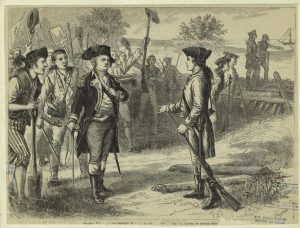
And it was for this idea – this fragile and audacious dream – that in June 1775, Dr. Joseph Warren left the comfort of a flourishing medical practice for the blood and dust of a small redoubt on Breed’s Hill, just north of Boston.
Dr. Joseph Warren was no stranger to duty. Born in 1741 on a farm in Roxbury, he lost his father at age 14 when the elder Warren fell from a ladder while harvesting apples. Young Joseph attended Roxbury Latin School, graduated from Harvard in 1759, and briefly taught there before apprenticing in medicine. By his early twenties, he was one of Boston’s most respected physicians.
Warren was also a widower raising four young children after his wife Elizabeth died in 1773. Yet he was stirred by the revolutionary cause. He joined the Sons of Liberty, drafted the fiery Suffolk Resolves that helped unite the colonies, delivered the stirring 1775 oration on the five-year anniversary of the Boston Massacre while British officers sat in the audience, and stepped into Samuel Adams’s shoes to lead the Massachusetts Provincial Congress.
On the night of April 18, 1775, Warren received intelligence that British regulars were preparing to march out of Boston. He understood instantly what it meant. The Crown intended to seize colonial powder stores and arrest Patriot leaders. Hesitation would mean defeat before the war even began.
He quickly dispatched Paul Revere and William Dawes into the night with orders to warn Lexington and Concord. Then Warren crossed the Charles River, slipped past British patrols, and rode toward the gunfire. At Lexington, a musket ball tore through his wig. At Concord, he helped organize the militia response that drove the British back toward Boston in a running fight.
Two months later, on June 17, the war reached its first trial by fire.
Patriots had fortified Breed’s Hill, a forward position overlooking Boston and Charlestown. The earthworks were crude – hastily thrown-up walls of dirt and timber – but they were all that stood between the British and the high ground dominating the harbor.
Warren had just been commissioned a major general. He could have commanded, as was tradition, from safety, or directed the battle from the rear. He did not. Instead, he walked into the redoubt and asked those present how he may best serve the cause.
As the rebels waited for the British Army to appear at their front, the Boston sun beat down mercilessly. The air was thick with the smell of fresh-turned earth, gunpowder, and sweat. Across the water, British warships thundered with cannon fire, engulfing nearby Charlestown in flames, sending black smoke rolling across the peninsula.
Those waiting – the farmers, blacksmiths, and shopkeepers comprising the militia – were exhausted from digging through the night. Despite their preparation, powder and shot supplies were dangerously low and water on the hill scarce. Thirst gripped every throat.
Warren moved among the men not as a general, but as one of them. He encouraged them quietly, steadied nerves, and shared the danger. As the British drums grew louder, Warren lifted his musket and joined the firing line.
Wave after wave of British regulars in bright scarlet coats, bayonets gleaming, advanced in perfect formation up the slope. Warren and his band of rag-tag militia were face-to-face with the world’s greatest military power.
The British launched their first assault. It was met with a surprising and forceful discipline. Accounts say that the Patriot commanders urged their men to not fire “until you see the whites of their eyes.” The redoubt then exploded in a sheet of flame and lead. The British line staggered and broke, fleeing down the hill and back into their ranks.
They came again, and again, and the Americans kept pouring devastating fire into them. The Redcoats staggered, regrouped, and fixed bayonets for a third assault.
In the redoubt, the Americans shared the last of their powder, the last of their shot, and the fullness of their courage. They were outnumbered. They were undersupplied. They could not fire a full volley. They would be overwhelmed. Yet they did not move.
The British charged the redoubt in a furious assault, finally swarming over the walls. Savage hand-to-hand fighting with muskets, knives, fists ensued. The Americans expended their last ounce of courage for their fledgling nation that had not yet even declared its independence.
Warren turned toward those gathered with him to rally the remaining defenders when a musket ball tore into his head. He fell in the dust of the redoubt he refused to abandon.
The British took the hill that day. But the courage of Joseph Warren and his fellow Patriots captured the imagination of the colonies. Warren’s death became a rallying cry for a people still deciding whether liberty was worth its price. His body, stripped and mutilated by the British, would later be identified in a shallow grave by his friend Paul Revere, who recognized the dental work he himself had performed on Warren just weeks earlier.
In mid-April, Joseph Warren acted when hesitation would have doomed the cause. In mid-June, Joseph Warren stood on the battlefield with the men he led, even when rank offered him safety.
And today Joseph Warren rests among the giants on whose shoulders we now stand.
Warren never lived to see the nation he helped birth. But he understood something about which we need constant reminder: A free republic is held together by the quiet courage of citizens who step to the front of the firing line.
Today, our threats are different – cultural fragmentation, institutional distrust, and a political class that often confuses rhetorical bluster with selfless service. But the remedy is the same. A free people endure when they take responsibility for their communities, their families, their schools, and their civic life.
Warren’s generation handed us a republic. Whether we keep it depends, as it always has, on whether we are willing to do what he did – to see clearly, act decisively, and stand our ground when the moment demands it.
Phill Kline is a former state legislator and the former Attorney General of Kansas. He is currently a law professor.
