
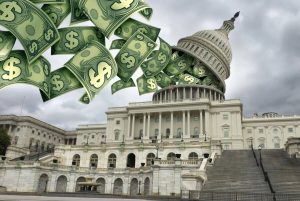
Taxes are inevitably on the mind of American voters every April 15, and this year is no different – although the burden is far lighter thanks to President Donald Trump’s “One Big Beautiful Bill.”
Democrats know just how popular those tax cuts are, and with the midterms and the 2028 presidential election looming, they are suddenly trying to shed their tax-and-spend identity. But a long history of high-tax excess gives voters every reason to be skeptical of this apparent change of heart.
Clearly attempting to take a page out of President Donald Trump’s playbook, New Jersey Democrat Sen. Cory Booker has proposed eliminating federal income taxes on the first $75,000 of income by increasing the standard deduction.
Meanwhile, Maryland Democrat Sen. Chris Van Hollen – another name that has been floated as a potential 2028 presidential hopeful – has rolled out a similar pitch for “working Americans.”
Vermont Sen. Bernie Sanders has given the tax cuts message his own socialist spin, pushing a wealth tax on the ultra-rich in order to finance direct payments to everyone else – a pure Marxist redistribution scheme.
On the surface, all these proposals seem like a striking about-face from the party that spent years attacking Republican middle- and working-class tax relief as a giveaway to the rich.
But this shift is hardly the result of some Democrat reckoning with economic and political realities. Democrats understand that tax cuts are popular, and Trump’s tax agenda holds strong appeal with voters. So, they’re doing their best to mimic it. As history shows, Democrats are masters of promising one thing during campaign season and delivering another if they win power.
One need only look at the voting record of the same Democrats now pushing “tax cuts” to see that their actions don’t match their rhetoric. Last year, Congress passed, and President Trump signed the One Big Beautiful Bill, extending key provisions of his popular 2017 tax cuts and averting a major tax increase scheduled for 2026.
Broad bipartisan majorities of Americans support these tax relief measures. Yet not one single Democrat in Congress voted for the bill. That includes Booker, Van Hollen, and Sanders.
Just to the south of D.C. in the Commonwealth of Virginia, Americans can see another glimpse into the reality of empty Democrat promises. New Governor Abigail Spanberger, a supposed “moderate,” ran on an affordability agenda, including specific promises to work with either party to abolish the car tax and lower costs for working families.
But immediately after taking power, Spanberger and her Democrat allies in Richmond proposed more than 50 new taxes. Democrats killed multiple Republican proposals to eliminate the car tax. Just this week, Spanberger signed a bill returning Virginia to the Regional Greenhouse Gas Initiative, a policy that is expected to impose a de facto $500 million annual power bill tax on everyone who pays for electricity.
Americans should pay attention to what’s going on in Virginia because it is what is in store for the entire country if Democrats take back the House and Senate this year and the presidency in 2028. They’ll say whatever they need to say to get elected, regardless of the feasibility of their promises.
Even if we are to take Democrats at their word, their proposals do not stand up to basic scrutiny.
Booker’s pitch, for instance, would not simply let Americans keep more of what they earn and call it a day. It would also expand the child tax credit, broaden the earned income tax credit, and add a baby bonus.
All that sounds great. But what Booker isn’t saying is that he’s also planning to pair that with a gargantuan expansion of the welfare state and costly government programs. Then comes the inconvenient question no liberal wants to hear: Who is going to pay for all that?
Booker’s answer is liberals’ favorite bogeyman – rich people.
Yale Budget Lab estimates that Booker’s plan would add trillions to the deficit. Eventually, that gap would have to be covered through some combination of more borrowing, higher taxes, or spending cuts.
Van Hollen’s proposal, involving an alternative maximum tax, is somewhat different in structure, but not in spirit. He presents it as “budget-neutral” because it pairs tax relief for some workers with a new surtax on higher earners. He also plans to preserve government spending by shifting the burden onto a narrower class of taxpayers.
But as states like California and New York are proving right now, squeezing the wealthy even harder doesn’t work. The top one percent of earners in the United States already contribute an astonishing 46 percent of all federal income taxes. Eventually, the wealthy will simply find new places to park their money that won’t punish them for success.
Sanders is even more explicit, proposing to tax the wealth of billionaires (not income) in order to cut checks to everyone else.
That is the common thread running through all these Democrat tax-cut pitches. None of them begins with the obvious premise that if Americans are overtaxed, Washington must be overspending. None of them seriously grapples with the fact that tax cuts are only sustainable when they are paired with spending cuts.
Instead, Democrats are peddling a politically convenient fantasy: lower taxes and free stuff for you, and someone else will pick up the tab. Democrats are not offering a smaller, simpler, more growth-oriented tax system. They are seeking to redistribute wealth through tax policy.
A real tax-cut agenda would begin with a far simpler idea than anything Democrats are now offering. If Washington wants to ease the burden on families, it cannot promise lower taxes for some Americans while preserving bigger government and forcing a smaller class of taxpayers to cover the difference. As the Tax Foundation notes, not all taxes are created equal, and taxes on wealth and capital are among the most damaging because they discourage investment, entrepreneurship, and long-term growth.
Democrats are trying to capture the popularity of tax cuts without accepting the discipline needed to make them real. There is no tax-cut revolution going on inside the Democrat Party. It is election-year demagoguery built on bad math and the same old socialist instincts.
Sarah Katherine Sisk is a proud Hillsdale College alumna and a master’s student in economics at George Mason University. You can follow her on X @SKSisk76.
