
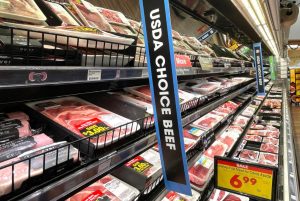
Beef prices have soared to record highs in 2026 even as farmers and ranchers are struggling more than ever to make ends meet. The culprit is an oligopoly in the meat packing industry and shady foreign players manipulating the market – and it is long past time that Congress did something about it.
If you’ve spent any time in the meat aisle at the grocery store recently, you’ve probably thought twice before tossing that package ground beef in the cart. While the price of other staples like eggs and milk have come down, the nationwide average cost of a pound of ground beef soared to an all-time high of $6.70 in March. That’s a 16 percent increase from a year ago, and a nearly 70 percent increase from 2021, when it averaged just $3.96 a pound.
Even worse, there’s no relief in sight. The U.S. Department of Agriculture estimates that beef prices will climb between 10 and 18 percent higher still in 2026.
Most of the coverage of this beef price shock blames America’s historically small beef herd, rising feed costs, and higher transportation costs as a result of climbing fuel prices. But the biggest piece of the puzzle may be the market dominance of the “big four” meatpacking companies – two of which aren’t even American.
An astonishing 85 percent of the U.S. beef market is controlled by just four firms – Tyson Foods, JBS, Cargill, and National Beef. As recently as 1980, these four companies controlled just 36 percent of the market. Today, they act like a cartel, setting prices and squeezing profits from farmers and ranchers.
Two of those companies, JBS and National Beef, are owned by Brazilian firms. U.S. beef imports from Brazil hit a record 197 million pounds in January 2025, up from just seven million pounds in January 2020.
What’s even more troubling is that in many cases, Americans don’t even know where their beef is coming from. Congress repealed country-of-origin labeling requirements for beef and pork in 2015, meaning meat processed in the United States can be labeled as a domestic product even if it originated overseas. At a time when foreign-owned firms dominate the supply chain, that lack of transparency should alarm consumers.
There are good reasons for concern. Brazilian meat companies have been linked to a long list of scandals involving food safety violations, corruption, environmental destruction, and even forced labor. In the notorious “weak flesh” scandal in 2017, companies bribed inspectors to approve rotten meat that had been treated with chemicals to mask spoilage. More recently, JBS agreed to pay $4 million to settle allegations related to child labor violations in its U.S. operations. These are serious breaches of trust in a system that Americans rely on to feed their families.
Meanwhile, mounting evidence suggests that the big four packers are exploiting their dominance at the expense of ranchers and consumers. During the COVID-19 pandemic, retail beef prices surged to record levels even as prices paid to cattle producers stagnated or declined. The gap between what consumers paid and what ranchers received – the so-called “packer margin” – exploded to historic highs. In a truly competitive market, that kind of divergence shouldn’t persist.
The courts are now being asked to weigh in. Last year, McDonald’s reached a settlement with Cargill after suing all four major packers for allegedly conspiring to fix beef prices in violation of federal antitrust law. The case is still ongoing against the other three firms. While no final judgment has been reached, the fact that these cases have advanced and in some instances resulted in settlements underscores that there is reason to suspect unlawful coordinated behavior.
In short, the beef packing industry – and the meatpacking industry in general – is defined by a highly concentrated market, parallel pricing behavior, massive and sustained margins, and repeated legal challenges alleging collusion.
This isn’t capitalism or the free market – it’s crony corporatism. A handful of massive firms, some with foreign ownership, dominate the market, operate with limited transparency, and use their scale to squeeze both producers and consumers. Ranchers are paid less for their cattle, families pay more at the grocery store, and the middlemen walk away with record profits.
To his credit, President Donald Trump has already begun to take action. Last November, he directed the Department of Justice to launch an investigation into potential collusion, price fixing, and market manipulation among the largest meatpacking companies. In December, he signed an executive order aimed at addressing security risks from anti-competitive behavior in the food supply chain. Those are important first steps, but they are not enough on their own.
The reality is that the most durable solution lies with Congress. And there is clear precedent for action. In 1921, lawmakers passed the Packers and Stockyards Act to break the grip of a previous generation of meatpacking monopolies. That law prohibited unfair, deceptive, and discriminatory practices and sought to ensure fair competition in livestock markets.
Congress can act again. It can require greater transparency in cattle pricing to restore true market competition. It can strengthen enforcement standards so regulators don’t have to clear impossible legal hurdles to hold dominant firms accountable. And it can support the development of new, independent processing capacity to give ranchers and consumers real alternatives.
None of this is radical. It’s a return to basic market principles – competition, transparency, and fairness.
Americans should be able to walk into a grocery store and buy affordable beef with confidence in where it came from and how it was produced. They shouldn’t be forced to pay inflated prices because a handful of politically connected corporations have rigged the system in their favor.
Shane Harris is the Editor-in-Chief of AMAC Newsline. You can follow him on X @shaneharris513.
