
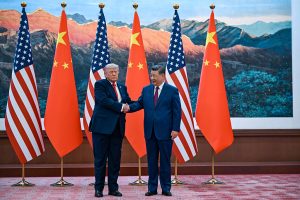
As President Donald Trump returned from his historic visit to China this week, Senate Minority Leader Chuck Schumer accused him of failing to deliver any progress on stopping the flow of fentanyl into American communities. But the facts tell a different story.
Just hours after Trump’s plane lifted off from Chinese soil, Xinhua, the Chinese government’s state-sponsored news agency, released a story detailing a new Ministry of Public Security crackdown on the cross-border sale of drug-making materials and psychoactive substances.
For years, Beijing has issued broad statements insisting it takes narcotics seriously. But this report was different. It actually listed specific cases and described arrests, seizures, sentences, fines, frozen assets, illegal websites, chemical companies, overseas buyers, cryptocurrency payments, and international freight networks that the Chinese government had cracked down on.
The most important admission was an acknowledgment that some Chinese criminals are still selling “sensitive chemicals” abroad, including controlled and uncontrolled substances that can be used to manufacture narcotics. In plain terms, these are fentanyl precursors, the chemicals used by traffickers, often through Mexican cartels, to produce the synthetic opioid that has devastated U.S. communities.
That matters because Beijing has long denied China’s role in the fentanyl crisis. The new report is a breakthrough in that it names the problem – a significant step. According to Xinhua, since 2025 Chinese authorities have resolved 29 related criminal cases, arrested 157 suspects, seized 720 kilograms of drugs, 1.3 tons of new psychoactive substances, nearly a kilogram of stimulants, and 27.7 tons of unlisted precursor chemicals.
The ten “typical cases” described by the Ministry of Public Security offered an unusually detailed picture of the drug trafficking networks involved. In one case, Chinese police said suspects built websites to advertise chemicals to foreign customers, arranged production through domestic contacts, used international freight companies to move the goods overseas, and collected payment in cryptocurrency.
In another case, authorities said they seized 10 tons of unlisted precursor chemicals before they could be moved abroad. In another, they dismantled two production sites, arrested 14 people, and seized 478 kilograms of finished synthetic cannabinoid precursor chemicals along with more than a ton of raw materials.
Dr. Otto von Muhlfeld, who advised German Interior Minister Friedrich Zimmerman on counter-narcotic policies in the mid-1980s, said, “The report on counter-narcotics efforts, viewed in this context, signals that China wished to be perceived as a country that approaches the issue with unprecedented seriousness.”
The report also landed almost immediately after Trump’s trip, following a major agreement he struck with China last November that included commitments to stop the flow of fentanyl into the United States.
Of course, no one should mistake a Xinhua dispatch for an independent report. China’s state media exists to serve the Chinese Communist Party’s political interests. But the Xinhua report does not stand alone. Just two days before it was published, The Guardian ran an analysis asking whether a breakthrough in the U.S. fentanyl crisis had begun in China. The article noted that U.S. overdose deaths have fallen sharply and that some experts believe moves to restrict Chinese precursor chemicals may have disrupted the fentanyl supply chain.
Keith Humphreys, a Stanford University professor who has studied the issue, put the matter plainly. “There was a supply shock,” he said. “The purity of fentanyl fell. The question is why was there a supply shock. And most indicators point to China.”
The Guardian also reported that the decline in fentanyl purity was visible in law enforcement seizures from May 2023 through the end of 2024, and that Canada saw a similar drop. Because the United States and Canada markets both rely on precursor chemicals sourced from China, researchers concluded that the disruption likely began near the source.
That does not mean the crisis is over. Nor does it mean Beijing has suddenly become a reliable partner. China has shown for years that when it wants to control a sector, it can do so aggressively.
Sara Carter, director of the White House Office of National Drug Control Policy, made that point at the U.N.’s annual meeting in Vienna, contrasting China’s tight grip on rare earth minerals with its lax handling of chemical exports. “We know that China’s weak export controls and lax enforcement allow its chemical industry to foster friendships with the cartels,” Carter said. “At the same time, China’s overly effective controls over rare earth minerals wreak havoc on legitimate industries.”
That contrast has always been the core of the problem. China cannot plausibly claim helplessness. It has the surveillance capacity, police power, export bureaucracy, and political will to regulate strategic industries when doing so benefits the regime. The question has never been whether Beijing can act. The question has been whether an American president can impose enough pressure to make inaction more costly than enforcement.
Trump appears to be doing exactly that. By making fentanyl a central foreign policy issue, targeting the cartels, imposing pressure on China’s role in the supply chain, and forcing Beijing to make public commitments, he has pushed the issue from diplomatic talking point to measurable action.
“Beijing recognized the President’s seriousness regarding the matter,” Dr. von Muhlfeld said. “It appears he has achieved success.”
That success remains fragile. But after years of denial, China is now publicly acknowledging the export of dangerous precursor chemicals, announcing arrests, detailing seizures, and presenting enforcement as a national priority. For the American families losing loved ones to fentanyl, that is not everything. But it is real progress.
Ben Solis is the pen name of an international affairs journalist, historian, and researcher.
