
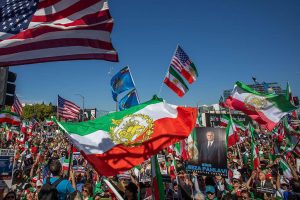
There are many geopolitical interests, some of them quite opposed to each other, at stake in the current U.S.-Israeli intervention in Iran. In fact, there are so many that if this action fully succeeds, it changes everything.
While the Islamic Republic of Iran is only a regional troublemaker, it has become, through its role as a major state sponsor of terrorism and its relationships with the world’s anti-democratic forces, an unavoidable player in the current problematic global order.
If regime change happens in Iran, then the dynamic balance between the world’s democratic states and the totalitarian states undergoes a significant shift.
While U.S. Democrats and isolationist Republicans are focused on narrow partisan interests, President Trump has come to see the big picture of what is at stake in Iran. His European allies, weakened by recent waves of hostile immigration and shocked by a sudden necessity to bear a greater burden of their own security, have been paralyzed as the Iran crisis unfolded. Only now, with the intervention fully underway, have they come to realize how much stake they have in the outcome.
For Israel, of course, the issue has always been existential. But a major new factor has been the reaction of neighboring Arab states, most of which considered the tiny but persistent Jewish state their mortal enemy since it was founded in 1948.
Over time and after several violent wars, these states came to realize that Israel could not be abolished. One by one, they began to develop relationships with their former enemy. With the Abraham Accords, initiated in President Trump’s first term, the relationships became formal and more interactive.
Meanwhile, Iran continued an opposite course, establishing and funding “proxy” terrorist forces like Hamas in Gaza and the West Bank, Hezbollah in Lebanon, the Houthis in Yemen, jihadist militias in Iraq, and the government in Syria.
At the same time, in the wake of the end of the Cold War, which had set the Western democracies against the Soviet Union and China — and their growing list of allied states, including Moscow’s vassal states in Central Europe, North Korea, nations in Southeast Asia, Cuba, Venezuela, some African regimes, and Iran – a new global order emerged.
The sudden invasion of Hamas into Israel on October 7, 2023, was intended by the Iranian regime to finally change the regional order of the Middle East. Apparently, Hezbollah and other Iranian proxies were supposed to join Hamas in the destruction of the Jewish state, but they hesitated while Israel quickly mobilized and turned back the invasion.
Thwarted, Iran is fully committed to the development of its ultimate threat of intimidation, nuclear weapons. This represented mortal risk to Israel, and with Iran’s simultaneous development of long-range ballistic missiles, a potentially lethal threat to nations far away, including Europe and the U.S.
Ignoring earlier agreements that it would not develop nuclear weapons, Iran continued to enrich uranium to weapons-grade and secretly made efforts to build a nuclear bomb. When Israeli and U.S. intelligence determined in 2024 that the regime was getting close to succeeding, the coalition of Israel and the U.S. successfully acted to cripple Iran’s weapons capability, but they left Ayatollah Khamenei and his radical government in place.
It soon became apparent to Israel and the U.S. that Iran had not only restarted its nuclear weapon development, but had also begun to create intercontinental ballistic missiles which could reach Europe and the U.S. with nuclear warheads.
Considering its 47-year history of hatred and violence against Israel and the U.S. and its long record of sponsoring global terror, it became clear to President Trump and Prime Minister Netanyahu that only a prompt and drastic change in Iran could eliminate the threat.
In December 2024, the U.S. precipitated a collapse of the Iranian currency. This led to severe economic hardships for Iranian citizens, already long-suffering under the Islamic police state. Public protests in the capital of Tehran soon grew into a nationwide movement which Khamenei and the Iranian Revolutionary Guard Corps (IRGC) ruthlessly put down, killing more than 32,000 unarmed civilians, wounding tens of thousands more, and imprisoning and torturing an even larger number.
This brutality, combined with the regime’s continued secret development of aggressive weapons, moved President Trump to action. Setting down demands which the radical regime was not willing to accept, a period of diplomacy was used to mobilize the American and Israeli military forces in the Middle East.
That accomplished, the U.S. and Israel awaited an opportunity to begin their operations with a stunning blow that would remove the Iranian leadership.
This occurred on the morning of Saturday, February 28, when 40 of the top regime leaders assembled for a meeting in Tehran.
Precision-aimed missiles sent from planes far from their targets instantly destroyed the meeting place, wiping out Supreme Leader Khamenei and the other leaders. Then, both Israel and the U.S. military commenced an unprecedented attack on Iranian military defense facilities throughout the country with waves of airstrikes that were followed by the systematic demolition of the regime’s military resources and personnel.
Virtually the entire Iranian navy has been sunk, including all of its largest ships and personnel. Factories producing munitions, missiles, and military equipment were destroyed. Airfields were made useless, and IRGC stations and housing were razed to the ground. The parliament and the other government buildings were demolished. Many of the remaining regime leaders were eliminated.
The Islamic Republic responded, as expected, with hundreds of drones and missiles aimed at Israeli cities and U.S. military facilities in the region. Most of these weapons were destroyed before reaching their targets, but some did inflict damage and casualties, although very limited.
The regime, its control and command decapitated, began to fire its missiles and drones at neighboring civilian targets in Saudi Arabia, the United Arab Emirates, Kuwait, Qatar, and other non-belligerent states to intimidate them into pressuring the U.S. and Israel to stop their offensive. But the result was instead to provoke these hitherto neutral Arab countries to unite against Iran and join their forces against it.
Iran’s proxies in Gaza, Lebanon, and Iraq initially remained silent. But when Hezbollah belatedly entered the fray, the IDF crushed their forces in Lebanon. President Trump has suggested that the United States is equipping the Kurds to attack Iran from the north.
Although Iran possessed substantial numbers of missiles and drones, it had a limited number of launchers. After five days, the Iranian military is reportedly running out of these weapons, with no significant way to replenish them. The IDF has destroyed almost all of the regime’s movable above-ground launchers. Now forced to use their limited number of fixed underground launchers, which, when used, can then be located and destroyed, the regime will soon be without a significant defense.
Encouraged by direct messages from President Trump, Prime Minister Netanyahu, and Crown Prince Reza Pahlavi to defect, Iranian Army and IRGC soldiers are reportedly either fleeing the country or switching sides in increasing numbers. Many others are being eliminated by Iranian civilian resistance fighters.
Iranian civilians have been advised to stay inside while operations to destroy the military and police capabilities of the Islamic regime are underway. With that goal now in sight, those civilians soon will be encouraged to return to the streets and retake control of the nation by overwhelming the Islamic jihadists who remain.
Although President Trump has suggested the final collapse of the regime might be many weeks away, the overwhelming success of the U.S. and Israeli military could well lead to this collapse within days. The collapse of the Soviet Union, it should be remembered, took place suddenly and was unpredicted by most Western observers.
This scenario is supported by the irony that the predictions of the Islamic regime leaders and many pessimists on the other side that action against Iran would lead to a wider conflict has come true — but only as an almost complete regional opposition to the Islamic regime as neutral Arab nations joined the U.S. and Israel, and the former proxies were silent.
Although jihadist terrorism will not disappear, and other anti-democratic nations still exist, this irony also suggests that the end of the radical jihadist Iranian regime will bring huge changes in and far beyond the Middle East itself.
Herald Boas is a writer for AMAC Newsline.
