
Photo Credit | Ca.gov
California’s high-speed rail project has become an infamous symbol of government waste — more than $15 billion spent and not a single mile of track laid. But now the state has a new entry on its wall of shame: a wildlife bridge over the 101 Freeway that has already cost more than $100 million and still isn’t finished.
When Governor Gavin Newsom broke ground on the Wallis Annenberg Wildlife Crossing in 2022, the project was sold as a roughly $92 million undertaking with a 2025 finish date. Newsom said the state had committed $54 million and promised another $10 million to finish the project, according to City Journal. Private donations, including a $25 million grant from the Annenberg Foundation, were supposed to cover the rest.
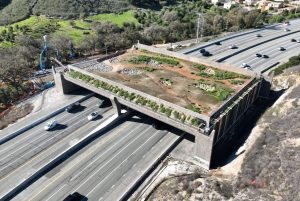
The price has since ballooned to more than $114 million — about $21 million above the earlier projection — and the completion date has slipped into late this year. State funds now account for roughly $77 million of the total cost, shattering Newsom’s promises to keep costs low. Photos of the unfinished bridge today show an ugly concrete platform over the 101 with no ramps on either side.
Environmental activist and WAWC leader Beth Pratt said that stage one actually came in under the original estimate, but stage two proved more expensive. In a swipe at the Trump administration, Pratt blamed the higher price on a mix of tariffs, inflation, and labor problems, saying the later bid came back “wildly high” after economic conditions had changed.
But California had already made its public commitment before any of those factors materialized. A “wildly high” bid can reflect real cost increases. It can also reflect a rational response to a weak buyer. Once California completed stage one, contractors no longer faced a customer free to walk away — they faced a state already locked into the project and therefore in a poor position to bargain.
So, where is the money going? What is clear is that a sprawling network of contractors, consultants, nonprofits, and government agencies has grown up around this crossing, many of them with a financial stake in prolonging construction. The more the project grows – and the more slowly it grows – the more people become invested in its continuation.
The justification for all of this is preserving genetic diversity in the mountain lion population of the Santa Monica Mountains. City Journal cites a 2016 paper describing the local population as “demographically vigorous,” while also highlighting extinction risk if genetic diversity keeps falling.
Fair enough. But was a nine-figure bridge really the only way to solve that problem?
As 441 notes, research suggests introducing one new mountain lion per generation from outside the area may solve that problem. In other words, California had options, and it seems to have chosen the most expensive one.
The bridge’s defenders use job creation as a selling point. The Wildlife Crossing Fund, citing Caltrans, claims that “for every $1 billion spent” on wildlife crossings, “13,000 jobs are created.”
But those jobs aren’t tied specifically to wildlife bridges. The same funds, invested elsewhere, would also create jobs. When job creation becomes a primary justification, it usually means the case for the project on its own merits is weak.
Californians ought to recognize this trope by now. The state’s high-speed rail authority has been making similar assurances since voters approved the project in 2008 — touting thousands of construction jobs as a key benefit — on the promise of a $33 billion system linking Los Angeles and San Francisco by 2020.
The current estimate of funds needed to complete the project now exceeds $125 billion, and the completion date has been pushed back by years.
Yet the project lumbers on, sustained not by results but by the sheer mass of contractors, agencies, and politicians who depend on it for a living. The wildlife crossing looks like a smaller version of the same scheme.
“People here are working really hard to keep costs down,” Pratt insisted in a video update earlier this year. “There is not stuff being wasted or any fraud or anything. It’s what it takes to build this.”
But that claim is dubious at best. The nursery in charge of propagating vegetation for the bridge prioritizes hiring Indigenous workers who begin every seed collection with an “offering” to the plants as payment for their seeds. One co-manager described her offering in a video: native tobacco, sagebrush, or pieces of her own hair, cut during full moons.
If only the bridge could be paid for in ceremonial offerings. Instead, it is paid for in tax dollars, and every dollar on this $114 million bridge is a dollar not spent fixing California’s crumbling roads, preventing the next devastating wildfire, or getting the homeless off the streets.
California has yet to find a budget it couldn’t exceed, a deadline it couldn’t miss, or a problem it couldn’t blame on someone else. The wildlife crossing is simply the latest entry in a long and expensive tradition — and there is no reason to expect it to be the last.
Sarah Katherine Sisk is a proud Hillsdale College alumna and a master’s student in economics at George Mason University. You can follow her on X @SKSisk76.
