
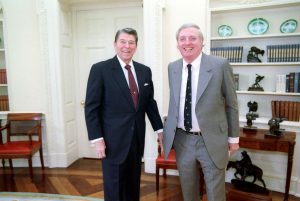
President Ronald Reagan Meeting with William F Buckley in the Oval Office (1/21/1988).
Sometimes, for reorientation, we have to look up from the compass, do a 360, and look behind us to understand where we are. The same is true for conservatives in politics. So, where are we?
In 1950, a religiously grounded, hard-working young man named William F. Buckley got accepted to Yale. He did well, but was shocked that professors actively pushed students to reject God. Their arrogance and ignorance stunned him, so he wrote a book about them, “God and Man at Yale.”
He made it clear that the institution was more concerned with self-worship than with Godliness. To say such a thing in 1951, when he wrote the book, to pop the Ivy League in the nose, was bold. He did not care.
He wrote: “I believe that the duel between Christianity and atheism is the most important in the world. I further believe that the struggle between individualism and collectivism is the same struggle reproduced on another level.” Sound familiar?
Learning without faith, history, freedom of thought, individual liberties, and knowing where those come from was folly. To push communism was simply evil.
In time, he founded “National Review,” a conservative magazine that took issue with liberals, began reeducating America on founding values, just as AMAC confronts AARP.
Buckley, whose courage empowered him to speak truth to power and shine light on things that others dared not, brings to mind AMAC’s founder, Dan Weber, who did the same.
Buckley then founded “Firing Line,” the longest-running public affairs television debate in history, 1500 episodes, wrote columns, books, and became a national conservative voice.
Buckey’s wit was famous, and not surprisingly, he and Reagan were close friends, both using humor to educate Americans on history, faith, conservatism, and common sense.
“Liberals claim to want to give a hearing to other views, but then are shocked and offended to discover that there are other views,” and “I would rather be governed by the first 2000 people in the Manhattan phone book than the entire faculty of Harvard,” he quipped.
Funny, Christian, speaker of many languages, unwilling to suffer fools, his lines are memorable. He hated government overreach, joking: “Decent people should ignore politics, if only they could be confident that politics would ignore them.”
A lover of classical music, he was a “happy warrior,” an unapologetic optimist. “Life can’t be all bad when for ten dollars you can buy all the Beethoven sonatas and listen to them for ten years,” he said. He might not like today’s music, but would listen to classical on his phone.
He was a moral, economic, and national security conservative. “Liberals …are generous with other people’s money, except when it comes to questions of national survival, when they prefer to be generous with other people’s freedom and security.”
Like Reagan, Buckley was an uncompromising anti-communist, explaining the moral bankruptcy in collectivism, concentrated power, and communism. “Back in the thirties, we were told we must collectivize the nation because the people were so poor. Now we are told we must collectivize the nation because the people are so rich.”
As if here now, he had no time for shaded truth, professors who worshiped themselves and promoted radicalism, forgot logic. “The academic community has in it the biggest concentration of alarmists, cranks, and extremists this side of the giggle house.”
A free market advocate, his lines gave the unthinking pause. “Industry is the enemy of melancholy,” and “There is an inverse relationship between reliance on the state and self-reliance.” In other words, work fixes what ails you, makes you proud of doing it yourself.
Finally, all his life – the way the “Turning Point” members do – he reasoned, summoned the power of faith in debate. “Conservatives should be adamant about the need for the reappearance of Judeo-Christianity in the public square,” wrote Buckley.
So, here we are –doing the 360 look around, and there he is, putting wind in our sails. We seem to be right where William F. Buckley was in 1951, more so. Grateful for his example, there is much to learn from his courage, wit, and well-reasoned conservatism.
Maybe the most moving aspect of looking back is that you sometimes find things you did not expect. Bill Buckley on gratitude is, by itself, a great reminder of what matters.
“To fail to experience gratitude when … exercising our freedom to speak, or … to give, or withhold, our assent, is to fail to recognize how much we have received from the great wellsprings of human talent and concern that gave us Shakespeare, Abraham Lincoln, Mark Twain, our parents, our friends.”
Finally: “We need a rebirth of gratitude for those who have cared for us, living and, mostly, dead. The high moments of our way of life are their gifts to us. We must remember them in our thoughts and in our prayers, and in our deeds.” So true.
Robert Charles is a former Assistant Secretary of State under Colin Powell, former Reagan and Bush 41 White House staffer, Maine attorney, ten-year naval intelligence officer (USNR), and 25-year businessman. He wrote “Narcotics and Terrorism” (2003), “Eagles and Evergreens” (North Country Press, 2018), and “Cherish America: Stories of Courage, Character, and Kindness” (Tower Publishing, 2024). He is the National Spokesman for AMAC. Today, he is running to be Maine’s next Governor (please visit BobbyforMaine.com to learn more)!
