
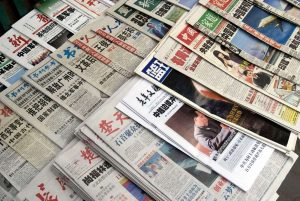
The federal case against former Arcadia, California, Mayor Eileen Wang for acting as an illegal agent of the People’s Republic of China (PRC) is one of the most alarming foreign influence scandals in recent memory. But it is also just the tip of the iceberg. Wang’s case offers a rare public glimpse into Beijing’s “United Front” strategy, a sprawling influence operation that uses community media, civic organizations, local political networks, and trusted public figures to launder Chinese Communist Party (CCP) propaganda into American life.
This should not be understood as an isolated scandal or a one-off lapse in judgment. For years, U.S. officials have warned that the CCP does not limit its influence operations to Washington. Beijing also targets statehouses, city halls, universities, ethnic media, business associations, and diaspora communities, where its messaging can appear organic and local.
The “United Front” is one of the oldest instruments in the CCP’s revolutionary arsenal. Its roots go back to the 1920s, when the young Communist Party entered tactical alliances with the Kuomintang and other non-communist forces in order to survive, expand, and defeat stronger enemies.
Mao later elevated the United Front as a strategy into one of the Party’s “three magic weapons,” alongside armed struggle and Party building. In practice, it meant organizing non-Party groups, sympathetic elites, ethnic communities, business leaders, intellectuals – and the overseas Chinese diaspora – around objectives set by the Party, even when those objectives were hidden behind the language of patriotism, friendship, dialogue, or cultural exchange.
According to the Justice Department, Wang and a colleague promoted CCP propaganda in the United States for Chinese officials from 2020 to 2022. Investigators said she helped run a website that masqueraded as a reliable local resource while spreading Beijing’s preferred narratives. Wang pleaded guilty to acting as an illegal agent of the PRC earlier this year.
In other words, Wang – whether wittingly or unwittingly – acted as a tool of the United Front strategy.
This is precisely how modern United Front work functions. It does not always announce itself with red flags and portraits of Xi Jinping. Beijing understands that propaganda is more effective when Americans do not recognize it as propaganda.
Wang’s own record makes the United Front connection impossible to ignore. She was a proponent of bringing Taiwan under Chinese control, a major priority of the CCP. She was even quoted on her propaganda website as saying, “I plan to carry forward the unfinished legacy of my revolutionary ancestors.”
Defected CCP officials have long warned that Beijing sees politically connected diaspora figures as especially useful. “Politicians with ties to China are often United Front operatives by default,” one anonymous defector told me. The bluntness of that warning should not be misunderstood as a claim about Chinese Americans generally, but as a warning about how the CCP seeks to exploit ethnicity, heritage, business ties, and community status to recruit soldiers for its political warfare.
Mao established the United Front as a covert campaign for ideological warfare against adversaries, uniting outside groups under Party coordination. Professor Jun De Níng, an advisor to former Chinese leader Hu Yaobang, said Mao believed the United Front’s “impact depended on context and could help, paralyze, or destroy its target.” Mao saw it as “blending military and political tactics, requiring all obstacles to be cleared before deploying the PLA.” That worldview still shapes Beijing’s operations abroad.
The clearest example in Wang’s case involved Xinjiang. In June 2021, she posted a link to a Los Angeles Times letter written by Zhang Ping, China’s consul general in Los Angeles. Zhang denied that Beijing was committing genocide or using forced labor in Xinjiang, insisting that “there has never been genocide in Xinjiang or forced labor in the region’s cotton fields or any other sector.” He even described Xinjiang cotton picking as “a good-paying job.”
The timing was significant. In 2020 and 2021, reports of forced labor, mass detention, forced indoctrination, forced sterilization, and torture in Xinjiang were shocking the world. The Trump administration had determined that China was committing genocide. International pressure was building around Xinjiang, which represented a major economic and reputational vulnerability for Beijing.
At the same time, the People’s Uyghur Tribunal in London was hearing testimony about atrocities against Uyghurs and other Turkic Muslim minorities. Witnesses described imprisonment and indoctrination meant to erase Uyghur identity. Survivors recounted torture, sexual violence, and forced sterilization. Sir Geoffrey Nice, who prosecuted Slobodan Milosevic, said the forum aimed to create a permanent record of crimes.
For Beijing, the propaganda stakes were enormous. A letter from a Chinese diplomat in a major California newspaper was useful. But its reach could be greater still if amplified through a website that appeared to be a local community news source trusted by Chinese American readers.
That is why Wang’s reposting mattered. It was part of a broader information battle over whether Americans would see the CCP’s conduct in Xinjiang clearly, or whether Beijing could muddy the waters through repetition, denial, and locally packaged messaging.
By December 2021, the Uyghur Tribunal concluded that China had committed genocide against Uyghurs by imposing measures intended to prevent births. But even as evidence mounted, Beijing’s line did not change. In November, Wang’s website published the transcript of a Chinese Foreign Ministry press conference in which a spokesman claimed that U.S. accusations of genocide and forced labor “only make Chinese people laugh.”
Chinese dissidents I spoke to said the site influenced Chinese American opinion, likely its main goal. In mid-2021, revelations from Xinjiang shocked much of the Chinese community abroad. Some renounced Chinese citizenship and community leaders distanced themselves from Beijing. This caused panic inside the Party, prompting Xi Jinping to mobilize the United Front to restore control and counter negative perceptions, “to tell the China’s story.”
Dr. Xiàhóu Li Wei, a former top CCP official, said the Party takes this war seriously. He described the United Front strategy as “spreading Party views abroad, confronting opponents, and turning foreigners into CCP assets.”
That is the real lesson of the Wang case. The CCP threat is not limited to spies stealing secrets or lobbyists pushing policy in Washington. It is also the quiet conversion of local institutions into transmission belts for foreign propaganda.
America cannot afford to treat cases like this as isolated scandals. The CCP’s United Front strategy is designed to work below the surface, inside the ordinary institutions of democratic life. The Wang case exposed one small piece of that machinery. The question now is how many more remain hidden in plain sight.
Ben Solis is the pen name of an international affairs journalist, historian, and researcher.
