
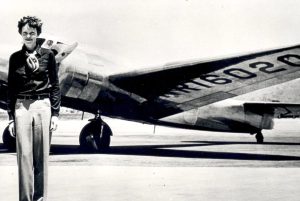
On July 2, 1937, Amelia Earhart, one of the most celebrated aviators in American history, disappeared over the Pacific Ocean while attempting to fly around the world. Earhart and her navigator, Fred Noonan, were flying a Lockheed Electra from Lae, New Guinea, to Howland Island, a tiny U.S.-controlled island more than 2,200 nautical miles away. It was one of the most dangerous legs of their journey—and it would be their last.
Earhart was already a national hero. In 1932, she became the first woman to fly solo across the Atlantic Ocean, proving herself in a field dominated by men and inspiring millions with her courage, independence, and determination. By 1937, she had set her sights on an even greater achievement: becoming the first woman to fly around the world near the equator. With Noonan’s navigation skills and her own experience in the cockpit, Earhart hoped the journey would mark a new milestone in aviation history.
The flight from Lae to Howland Island was especially difficult because Howland was so small and isolated. The U.S. Coast Guard cutter Itasca waited nearby to help guide Earhart by radio. As she approached the island, however, communication problems grew worse. Earhart’s messages indicated that she could not locate Howland and was running low on fuel. Soon after, radio contact was lost. Neither Earhart, Noonan, nor their aircraft was ever found.
President Franklin D. Roosevelt authorized a massive search involving U.S. Navy and Coast Guard ships and planes. Crews searched roughly 250,000 square miles of ocean, but no confirmed wreckage or remains were discovered. The Navy’s official conclusion was that Earhart and Noonan likely ran out of fuel, crashed into the Pacific, and drowned. Earhart was declared legally dead in January 1939.
Her disappearance quickly became one of the greatest mysteries of the 20th century. Over the decades, many theories have emerged, including claims that she landed on another island, was captured by the Japanese, or survived for some time after the crash. Despite repeated expeditions and renewed searches, the most widely accepted explanation remains that the plane went down near Howland Island.
Yet Amelia Earhart’s legacy is not defined only by how her life ended. She expanded the possibilities for women in aviation, challenged expectations, and became a symbol of bold American ambition. Her final flight remains a story of courage, risk, and the human desire to push beyond known limits.
Today, nearly nine decades later, Amelia Earhart’s disappearance continues to fascinate historians, aviators, and the public alike. But her greatest legacy endures in the example she set: to dream boldly, fly farther, and refuse to accept the boundaries others impose.
