
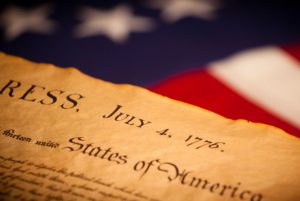
These United States we celebrate this weekend are a big and wondrous collection of beautiful places with a rich and glorious history. From coast to coast, we have endless tales of faith, honor, and glory battling it out with unbelief, dishonor, and shame on a massive landscape of mountains, hills, plains, forests, deserts, valleys, and coasts. Without leaving our nation, we can travel thousands of miles and find flora, fauna, weather, and climate of all kinds.
How can we sing of thee, our home and native land?
The American Book of Fables is a great help. Written by Matthew Mehan and illustrated by John Folley, this 395-page volume gives a panoramic view of America in words and illustrations that does some justice to it. It is the kind of book that would be great for a coffee table, a school, or a homeschooling family.
Mehan, associate dean and associate professor of government at Hillsdale College’s Washington, D.C., campus, is no mere policy wonk or even political philosopher. A Ph.D. in literature from the University of Dallas, he is the author of two previous children’s books, “The Handsome Little Cygnet” and “Mr. Mehan’s Mildly Amusing Mythical Mammals.” In the present volume, he has provided a rich collection of rhymes, songs, poems, tales, and historical documents in order “to remember our way of life or to learn it for the first time.”
The 13 chapters of The American Book of Fables are divided according to 13 regions of the American nation and correlated with a line, phrase, or section of the Declaration of Independence. Folley’s illustrations, especially the two-page color illustrations depicting the land and creatures of each section, provide a great deal to meditate on.
The contents of the chapters include materials marked specifically for “Littles,” those youngest readers; “Middles,” children old enough to read more in-depth material; and “Bigs,” the grown-ups who can learn and remember from it all. The end of the book includes a checklist of images to find for all three groups as well. Littles can check off “Easy Finds” such as a slice of pizza and the Statue of Liberty. Middles are challenged with “Not So Easy Finds” that include a smushed serviceberry, an astrolabe, and a Texas flag. Bigs are instructed that their list might require “some homework” for “Difficult and Historic Finds” such as Wild Goose Island and an 18th-century Philadelphia skyline.
The readings designated for the Littles are primarily rhymes and songs, many of which he borrows freely from Mother Goose collections or other early American collections of rhymes. Given that Mr. Mehan is the presenter, they are usually attributed to “Father Goose.”
Selections designated for the Middles are fables. Many are freely adapted from Aesop; some are new. What makes these a good deal of fun even for those who know the Aesop originals is that Mehan has transposed the stories from ancient Greece into the American settings that go with each chapter. Florida dolphins, black-footed ferrets and prairie dogs in South Dakota, and black hawks and pack rats from Utah all become the opportunities for lessons about manners, morals, prudence, and wisdom.
The Bigs get a very broad selection of excerpts from Aristotle’s Politics, letters and speeches from the Founding era, and a wide selection of historical accounts from the frontier, the old west, and numerous other places (and times) from our national history.
Also labeled as for the Bigs, but likely to be of great (perhaps greater) interest to the other two groups are the long stories in each chapter that tie the book together by recounting the adventures of Hugh Manatee of Florida’s Biscayne Bay. Hugh’s fellow manatees have been devastated by a tropical storm. He has been given the assignment of “visiting all America to seek their aid and teach them the firm and gentle ways of the manatee.”
Hugh’s travels, along with a host of other critter fellow travelers, allow him and the creatures they encounter to explain a great deal about the topography, animals, plants, and big events of each region. More importantly, Hugh can teach them all about the history and lore of the location and the country.
One of the running gags is that, in any discussion with the other animals, Hugh can pull from no-one-knows-where just the right book or old newspaper to read accounts of cattle drives from Texas to Kansas, Washington’s Farewell Speech, or any other bit that seems relevant.
The tales of Hugh are fairly cleverly written, with plenty of jokes and allusions that parents will get. I suspect that most parents will enjoy reading them to their children more than simply reading them silently to themselves. While I was often appreciative of the banter between the animals, I often felt like skipping to Hugh’s historical and literary selections of American wisdom and folly.
Nevertheless, there are plenty of passages in the Hugh Manatee stories that will make the Bigs think on their own for a while. In discussing the famous Chief Red Cloud’s life, Hugh speaks well on the “special heroic effort to live at peace with those who have wronged you, whom you have wronged, and with whom you have been at war for so long.”
There was only one section I refused to read—one in which Mehan offers that it was partly written by Grok, the A.I. developed by X/Twitter. The rest of the book was pretty good. My favorite parts were the collection of quotations at the end of each chapter, taken from the Bible, classical writers, and American wit and wisdom.
The American Book of Fables is a great resource for selections useful to those of us who write, teach, or speak on America. More importantly, it is a good long-term reading project for all ages, with plenty of science, literature, and history to take in. A QR code in the back allows parents to download two more documents Mehan and Folley prepared: The American Almanac of Animals and The Grand Old Glossary for The American Book of Fables.
While many writers have longed to write “the great American novel,” Mehan and Folley have given America a slightly different but also wonderful gift on her 250th anniversary: a great American storybook that takes us from sea to shining sea.
David P. Deavel teaches at the University of St. Thomas in Houston. A past Lincoln Fellow at the Claremont Institute, he is a Senior Contributor at The Imaginative Conservative. Follow him on X (Twitter) @davidpdeavel.
