
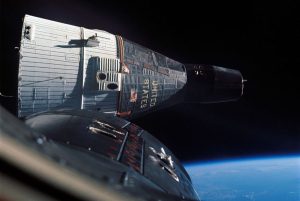
Gemini 6A was an all-important 1965 crewed United States spaceflight that served as an integral part of NASA’s Gemini program. The flight made significant contributions to the field of aeronautics and history that shall not be forgotten.
Precursor to future missions
In July of 1969, the first humans landed on the moon. The Apollo 11 mission, led by legendary astronauts Neil Armstrong and Edwin (Buzz) Aldrin Jr., was remarkable by all measures. However, the landing would not have been possible without predecessors like Gemini 6A.
The value of the Gemini program
Ahead of the Apollo missions, National Aeronautics and Space Administration (NASA), developed the Gemini program (1964-1966) to advance space science. Primary goals of Gemini missions included testing the ability of astronauts to maneuver their spacecraft by means of manual control, developing techniques needed for orbital rendezvous, and docking with a target vehicle. These procedures were essential to the subsequent Apollo Moon-landing program.
An historic mission
The Gemini spaceflights of 1965 and 1966 were designed to acquire the skills needed for the Apollo lunar landing program. NASA’s original Gemini mission was to dock with an uncrewed target vehicle. When the target vehicle failed, a newer alternate plan was created and involved meeting up with the already-orbiting Gemini 7 commanded by astronauts Borman and Lovell.
Aboard Gemini 6A, astronauts Walter M. Schirra Jr. (Wally) and Thomas P. Stafford (Tom) would be tasked with the historic “rendezvous” mission – which had never been successfully achieved before.
A third attempt
The triumphant launch of Gemini 6A was technically a third attempt. The original mission was intended to dock with an Agena Target Vehicle, but the Agena exploded 6 minutes after its launch on October 25, 1965, and the mission was cancelled. The second launch attempt was slated for December 12, 1965. That also failed shortly after ignition due to a mechanical failure. Once the issue was resolved, the third launch attempt would go on to be a success.
The vital mission
On December 15, 1965, with a crew of two aboard, and just 11 days after the launch of Gemini VII, Gemini 6A lifted off. Officially called Gemini VI-A, it was the fifth crewed Earth-orbiting spacecraft of the overall Gemini series. Their mission into space was significant, successful, and short, lasting only 1 day, 1 hour, 51 minutes and 24 seconds before splashing down in the Atlantic Ocean (northeast of Turks and Caicos Islands) to be recovered by USS Wasp. Even more exciting than the dramatic takeoff and impressive splashdown was the ability of Gemini 6A to remarkably come within feet of its sister spacecraft, Gemini 7.
Wally Schirra Jr., Command pilot of Gemini 6, shared his experience in the 1988 Naval Institute Press Bluejacket book entitled Schirra’s Space. Here’s an excerpt as shared by U.S. Naval Institute:
Gemini 6 finally made it into orbit on the morning of December 15. As we passed over the African continent, Borman and Lovell got a glimpse of our contrail. Over the Pacific, I turned the spacecraft 90 degrees to the south and ignited the aft thrusters. By the end of the burn, we were in the same plane as Gemini 7, with the gap reduced to 300 miles. As we got within a half mile of Gemini 7, I maneuvered with tender care. Then, as we moved within 100 feet, it was necessary to stop our velocity in relation to the velocity of Gemini 7, or we would have whizzed right on by.
“Having fun?” I radioed to Gemini 7 when we were 200 feet apart.
“Hello there,” Borman replied.
“There seems to be a lot of traffic up here,” I noted.
“Call a policeman,” Borman said.
All four of us were overjoyed. We had done something we spent years preparing for. We flew in formation for three revolutions of the Earth, moving from a range of 100 yards to just inches, window to window, nose to nose.
Secondary achievements
Gemini 6A and Gemini 7 could have docked should they have been equipped to do so. In addition to the monumental accomplishment of rendezvousing with another spacecraft in Earth’s orbit, the mission also included significant secondary objectives like station keeping, testing the visibility of rendezvous target, evaluating spacecraft reentry guidance capability, and conducting numerous other experiments.
The amazing crew of two
Wally Schirra would become the first astronaut to go into space three times, and the only astronaut to have flown into space in the Mercury, Gemini, and Apollo programs. In addition to two Gemini rendezvous missions, Tom Stafford commanded the Apollo 10 mission in 1969, the final test of Apollo systems before the first-crewed landing on the moon. Each made significant contributions to space exploration.
Other fun facts:
The Gemini 6A mission is also known for some fun facts:
It was advanced for its time. During the Cold War, the Soviet Union and the United States were in competition for progress in space. The Soviet Union led early with the first artificial satellite and first human in space. However, the Gemini 6A mission demonstrated U.S. technical superiority. The Soviet Union had previously launched pairs of Vostok spacecraft capable of establishing radio contact with each other. However, they lacked the ability to adjust their orbits to rendezvous and came no closer than several kilometers to each other.
There was a total of 12 Gemini missions (Gemini 1 through 12), which included two uncrewed and ten crewed flights between 1965 and 1966. Gemini 1 and Gemini 2 were test flights that did not carry astronauts. The remaining 10 missions were crewed, with each flight carrying two astronauts to test new procedures or long-duration (at that time) space flights. The program served as a bridge between the Mercury and Apollo programs and tested new techniques to include rendezvous, docking and spacewalks.
It marks the first time music was broadcast in space. Per Guinness World Records, “Jingle Bells” became the first song played in space when, on December 16, 1965, it was broadcast during NASA’s Gemini 6A space flight. Gemini 6 astronauts tricked NASA’s Mission Control by pretending they had spotted a UFO and played the holiday song on harmonica accompanied by miniature sleigh bells. “The pair were in high spirits having completed the first ever two-space-vehicle rendezvous in orbit with Frank Borman and James Lovell, Jr. in Gemini 7.”
It was the first recovery to be televised live. Original mission plans included the first live television coverage of the recovery of a U.S. spacecraft at sea from the recovery ship U.S. aircraft carrier Wasp. The Wasp was fitted with ground station equipment to relay live television via satellite. Gemini 6A was the first recovery to be televised live.
It was the first computer-controlled landing. Both the rendezvous and the landing were computer controlled using on-board guidance system to perform precise maneuvers. The flight performed the first successful controlled reentry and splashdown in the U.S. manned spaceflight program, landing in the Atlantic Ocean just miles from a predetermined point.
Visitors can visit the spacecraft. Gemini 6A capsule is currently on display at the Stafford Air & Space Museum in Weatherford, Oklahoma. It was previously displayed at the Oklahoma History Center in Oklahoma City and other places. Today, it remains on long-term loan from the famed Smithsonian Institution.
Creating new possibilities
The famous quote from astronaut Neil Armstrong, “One small step for man, one giant leap for mankind,” demonstrates the significance of a small action in the context of big history. Similarly, what occurred during Gemini 6A flight, the remarkable first crewed spacecraft to rendezvous with another, is of grand historical magnitude. Those technological contributions would pave the way for future space endeavors, making it possible for man to land and walk on the moon. It would also lead to new possibilities, enabling the United States to act as primary partner in the multinational International Space Station (ISS) and become a monumental contributor in the field of aeronautics and space exploration.
Disclosure: This article is purely informational and is not intended as a scientific publication.
