
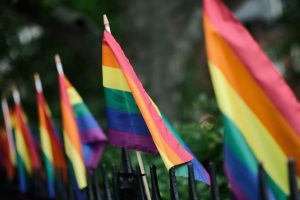
The LGBTQ+ movement, like all ideological movements of its kind, relies on new converts to survive and grow. But data increasingly shows that LGBTQ+ identification is in freefall among young people – perhaps indicating that we are witnessing its collapse in real time.
The first rumblings of a cultural shift came earlier this year. A February Gallup poll found that just nine percent of Americans identified as lesbian, gay, bisexual, or transgender in 2025 – a slight but significant drop from 9.3 percent in 2024.
On its face, that may not seem dramatic. But since Gallup first began asking this question in 2012, the number had only ever gone in one direction – up. That year, just 3.5 percent of Americans identified as LGBT. For more than a decade, the movement appeared to be on an unstoppable upward trajectory. Now, for the first time, it has reversed.
Shortly after the Gallup survey, political scientist Eric Kaufmann published findings from a massive study of 68,000 U.S. undergraduates. His results were even more striking. Just 3.6 percent of students identified as a gender other than male or female – down sharply from 5.2 percent in 2024 and 6.8 percent in 2022 or 2023. As Kaufmann stated, “the share of trans-identified students has effectively halved in just two years.”
Even more telling is what’s happening within the pipeline of new students on campus. Freshmen in the 2024–25 academic year were less likely to identify as trans or queer than seniors – the exact opposite of what was happening just a few years ago, when younger cohorts were driving the surge. That suggests not just a plateau, but a reversal.
Then came perhaps the most revealing data point of all. Psychologist Jean M. Twenge analyzed CDC data and found that among adults ages 18–24, identification as lesbian, gay, or bisexual peaked at around 20 percent in 2022 before dropping to just over 15 percent by 2025. That’s a 21 percent decline in just three years.
The steepest drop came among young women identifying as bisexual – a group that had previously driven much of the overall increase. This is an important distinction, as the percentage of young adults identifying as just gay or lesbian has remained more or less the same.
Put all of this together, and a pattern emerges that is impossible to ignore. LGBTQ+ identification does not look like a stable, innate characteristic expressing itself more freely over time, as liberals would suggest. Instead, it looks more and more like a social contagion that surged rapidly and is now receding.
For years, conservatives argued that the explosion in LGBTQ+ identification – particularly among young people – was not simply about long-suppressed identities finally coming to light. It was being actively driven by cultural forces, including Hollywood, academia, activist institutions, and a media environment that relentlessly promoted and normalized these identities while stigmatizing dissent.
Kaufmann himself made the comparison explicit, noting that “the fall of trans and queer seems most similar to the fading of a fashion or trend.”
From the 2010s through the early 2020s, LGBTQ+ identification followed a classic adoption curve. It built gradually, accelerating rapidly between 2020 and 2022, and has now entered a phase of decline. Could it reverse again? Possibly. Cultural movements are rarely linear. But at the moment, the zeitgeist has clearly shifted.
So, what changed?
There are several plausible explanations, and the answer is likely some combination of all of them.
First, the emergence of dissenting voices broke the illusion of unanimity. For years, questioning gender ideology came with enormous social and professional risk. But that began to change as de-transitioners started sharing their stories – often harrowing accounts of irreversible medical interventions pushed on them as minors. These stories cut through the abstract language of “affirming care” and forced a reckoning with real-world consequences.
Even some figures on the political left began to speak out, challenging the more extreme claims of transgender ideology despite intense backlash. That signaled to the broader public that skepticism was not only justified, but necessary.
Second, conservatives and grassroots activists played a sustained and often underappreciated role. High-profile moments helped – documentaries like Matt Walsh’s What is a Woman?, viral clips, and major public debates.
But just as important were the quieter efforts, simple things like parents speaking at school board meetings, individuals pushing back online, and communities organizing to protect children from ideological experimentation in classrooms. Over time, those efforts accumulated.
Third, the information environment itself changed. Prior to 2022, major social media platforms enforced strict ideological conformity on this issue. Dissenting views were often labeled “harmful” or “misinformation” and removed. That created a distorted perception of consensus, particularly among young people who live much of their lives online.
That all changed in 2022 with Elon Musk’s purchase of Twitter, now X. Musk destroyed X’s censorship infrastructure, exposing many young people to arguments challenging the dominant narrative – and they responded. The timing is impossible to ignore. The peak and subsequent decline in LGBTQ+ identification aligns closely with this shift in the digital landscape.
Finally, there is the simple explanation of young people simply moving on. Cultural fads come and go, especially among younger generations. What was once seen as rebellious or identity-defining can quickly become passé.
None of this means the issue is settled. Far from it. The LGBTQ+ movement remains deeply entrenched in many institutions and continues to push aggressively on multiple fronts. And the human cost of the last decade is real. There are young people who were placed on puberty blockers, cross-sex hormones, or subjected to irreversible surgeries before they were capable of informed consent. Cases like that of Fox Varian, who successfully sued medical providers after receiving a double mastectomy at 16, are likely just the beginning of a much larger reckoning.
Those individuals deserve accountability and justice.
But the broader cultural trend is undeniable. The data suggests that what was once presented as an inevitable march of progress may, in fact, have been something far more transient.
The rise of the LGBTQ+ movement was rapid. Its decline may be just as swift. The only question now is what comes next – and whether we’ve learned anything from this grotesque social experiment.
Shane Harris is the Editor-in-Chief of AMAC Newsline. You can follow him on X @shaneharris513.
