
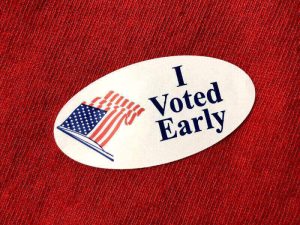
The US House, Senate, Gubernatorial, and legislative races this year will determine the future of President Trump’s term, what he can get done and not done, plus the future of 36 state governor races. Voting early may affect outcomes.
In 1996, 90 percent of Americans voted on Election Day. No more. In 2024, America saw “exceptionally high” turnout, which many trace back to the availability of more options for early voting, not requiring all to vote on one day.
In practical terms, 2024 saw more than half of all votes cast before election day, whether mail-in or early in-person at town offices around the country. The practical result was 153 million votes cast, front-loaded voting that produced a Trump win.
Going back in time, for reasons complex and not so complex, Republicans have tended – traditionalists that we are – to vote on election days, while Democrats pushed absentee and early voting.
Not surprisingly, whatever one’s party affiliation, life can interfere with voting on election day. In the natural course of events, sickness, work, and parenting requirements, even forgetfulness can reduce voter turnout relative to intent.
Since Republicans tend to vote in larger numbers on election day, and Democrats vigorously use early voting options, many races turned into nail-biters on election night last cycle, or were lost for Republicans, due to disinterest in early voting.
This is beginning to change, however. If Republicans choose to vote early in 2026 – both in primaries and the general election – the results may prove decisive. All the voter – in either party – has to do is go to the town office to vote now, in primaries from Maine to Minnesota. Republicans should do that, vote early.
In states like Maine, where so-called “rank choice voting” is pushed by Democrats in primaries, voters should go early and put one name across all fill-in-circles if they do not believe in “rank choice voting,” but one-person, one-vote.
By voting early at your local town office – before the primary date (in Maine, June 9) and putting just one name across all available choices, we assure that the vote is counted. We also uphold the Constitution, which never imagined “rank choice.”
Stepping back and looking at the entire nation, another important outcome will flow from Republicans voting early this critical election year, primary and general.
Candidates who win in early voting, especially Republicans who convince their supporters to vote early, tend to win. In the primary and November, this may prove decisive – permitting Republicans to prevail in the US House and Senate, preserving President Trump’s ability to lead without obstruction and new impeachments.
Bottom line: Republican voters may prefer to vote on election day or “primary election day” (in early June in many states). If so, they should. But the more votes a Republican candidate gets from early voting, the more likely they are to win.
That matters in primaries as much as the general election in November. Election integrity remains a big issue, vigilance the watchword, but time is coming when more Republicans vote early, and – on the numbers – that may help them win. So, what should you do if you can? Vote early!
Robert Charles is a former Assistant Secretary of State under Colin Powell, former Reagan and Bush 41 White House staffer, Maine attorney, ten-year naval intelligence officer (USNR), and 25-year businessman. He wrote “Narcotics and Terrorism” (2003), “Eagles and Evergreens” (North Country Press, 2018), and “Cherish America: Stories of Courage, Character, and Kindness” (Tower Publishing, 2024). He is the National Spokesman for AMAC. Today, he is running to be Maine’s next Governor (please visit BobbyforMaine.com to learn more)!
