
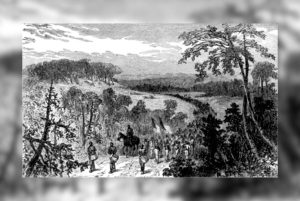
On May 1, 1863, the quiet countryside around Port Gibson, Mississippi, erupted into violence as Union and Confederate forces clashed in what would become a crucial turning point in the Civil War’s Western Theater. Known as the Battle of Port Gibson, the engagement marked the first major victory for Union General Ulysses S. Grant in his bold campaign to capture the Confederate stronghold of Vicksburg—a city whose control would determine dominance over the Mississippi River.
Grant’s strategy leading up to the battle was both risky and innovative. After months of failed attempts to approach Vicksburg from the north, he marched his army down the west bank of the Mississippi River, crossed south of the city at Bruinsburg on April 30, and moved inland. This maneuver placed his forces in a vulnerable position, but also caught Confederate defenders off guard. By the early hours of May 1, Union troops encountered Confederate outposts near Port Gibson, setting the stage for a daylong battle.
The fighting unfolded across rugged terrain filled with ravines, ridges, and narrow roads—conditions that favored the smaller Confederate force under General John S. Bowen. Despite being outnumbered nearly three to one, Confederate troops fought fiercely, repeatedly establishing defensive positions and attempting to halt the Union advance. However, the steady pressure of Grant’s larger army, particularly the corps led by General John A. McClernand, gradually forced them back. By evening, the Confederates were compelled to retreat north toward Vicksburg, conceding the field.
Though the battle itself was not the largest of the war, its consequences were profound. Union casualties totaled fewer than 900 men, while Confederate losses were also significant, including hundreds captured and several artillery pieces lost. More importantly, the victory secured a foothold for Union forces on Mississippi soil. It also forced Confederate troops to abandon nearby Grand Gulf, opening the door for Grant to push deeper into the interior of the state.
The success at Port Gibson demonstrated the effectiveness of Grant’s unconventional approach and exposed weaknesses in the Confederate defense of the Mississippi River. It was the first in a series of Union victories that would ultimately isolate Vicksburg, cut the Confederacy in two, and shift the balance of the war.
Beyond its strategic importance, the battle also symbolized a turning point in momentum. Grant, once criticized for earlier setbacks, proved his determination and tactical ingenuity. With Port Gibson behind him, he confidently advanced inland, setting in motion a campaign that would culminate in the surrender of Vicksburg on July 4, 1863—a decisive Union triumph.
Today, the Battle of Port Gibson is remembered not just as a clash of armies, but as the moment Grant gained the initiative in one of the Civil War’s most important campaigns. It was here that the path to Union control of the Mississippi River truly began.
