
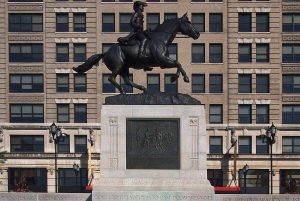
Photo Credit | Wikipedia – McGhiever
What’s old is new again as the press is having a collective meltdown over news that a statue of Founding Father and Declaration of Independence signer Caesar Rodney will be temporarily displayed in the nation’s capital as part of the Trump administration’s semiquincentennial celebration. While Rodney played a pivotal role in securing American independence, the liberal media is choosing to fixate on the fact that he owned slaves to denigrate his legacy.
According to the Department of the Interior, the statue of Rodney will be displayed for about six months in Freedom Plaza, a park in downtown Washington, D.C., after gathering dust in storage for the past six years. “The hard work and sacrifices of the men and women who built this nation deserve to be remembered and honored,” the department said in a statement.
But for woke corporate media newsrooms, the only relevant thing about Rodney’s life is the fact that he inherited about 200 slaves from his father. Late last week, The Washington Post reported that a “statue of enslaver to be displayed in D.C. for America’s 250th birthday” (the paper has since changed the headline amid backlash). The Hill also breathlessly relayed that the Trump administration plans “to display a statue of slave owner removed in Delaware,” while The New York Times brayed, “Park Service to revive statue of Founding Father who enslaved hundreds.”
Of course, none of these headlines allude to the fact that, while he did own slaves, Rodney introduced a bill in 1767 while he was speaker of the colonial assembly to prohibit the importing of slaves into Delaware, nor do they mention that he freed all his slaves in his will. Even more egregiously, the “journalists” having a conniption over a temporary statue display want readers to believe that owning slaves during a time when it was widely culturally accepted is somehow more important than Rodney’s contributions to the cause of liberty that would ultimately lead to the end of slavery in the United States.
While most Americans are familiar with the famous midnight ride of Paul Revere, a midnight ride by Rodney in July 1776 was just as consequential.
Rodney was one of three delegates from Delaware to the Continental Congress, which was then debating independence in Philadelphia. But stricken by cancer and severe asthma, Rodney was at home in Dover when he learned that the other two delegates were deadlocked. Mustering all the strength he had and pushing through what must have been extraordinary pain, he rode 80 miles overnight through a thunderstorm just in time to cast Delaware’s deciding vote for independence.
Legend has it that Rodney cast his vote soaking wet in his boots and spurs. Upon entering Independence Hall, he uttered these words:
As I believe the voice of my constituents and all sensible and honest men is in favor of independence, and as my own judgment concurs with them, I give my vote for independence.
Despite still suffering from cancer, Rodney’s service to the fledgling nation did not end there. He was Delaware’s wartime governor and major-general of the Delaware militia during the Revolution. George Washington bestowed his “sincerest thanks” on Rodney and described his character as being of the “highest honor.”
After the war, Rodney continued to serve in various government roles until cancer finally claimed his life in 1784. He was so well-respected by his colleagues that the Delaware General Assembly voted to meet at his home when he became too weak to travel.
This incredible life of patriotism and sacrifice earned Rodney status as Delaware’s most important Founding Father. One of Delaware’s two statues in the U.S. Capitol’s Statuary Hall depicts Rodney holding the Declaration of Independence. He has been featured on a state postage stamp and Delaware’s state quarter. Various government buildings, roads, and landmarks throughout the state bear his name.
And, in 1923, the city of Wilmington, Delaware, erected a majestic equestrian statue of Rodney in Rodney Square.
That statue stood until 2020, when it became just one of many casualties in the left-wing crusade to tear down statues – and ultimately the legacies – of founding-era heroes. The Democrat Wilmington city government removed the statue of Rodney and a nearby statue of Christopher Columbus in June of that year.
In October 2020, on Rodney’s 292nd birthday, President Trump issued a proclamation celebrating Rodney’s legacy and blasting liberal attempts to tear down America’s founding heroes. It is worth quoting at some length:
The empty pedestal in Rodney Square in Wilmington is the end result of an extreme anti-American historical revisionism propagated by organizations like the New York Times and its 1619 Project, critical race theorists on college campuses, cancel culture adherents in corporate boardrooms, and flag-burning mobs on city streets who seek to reframe our Nation’s history around the idea that the United States is not an exceptional country but an evil one. Caesar Rodney is an early casualty of these reckless “re-education” attempts that, if allowed to progress, will erase the names of every one of the heroes of 1776 from American memory and blot out their noble legacy from the history books… If Caesar Rodney cannot be defended, then there is no principle by which the other signers of the Declaration can be shielded from similar eradication.
What Trump warned about is not hypothetical – it is exactly what we are seeing play out again today. If the Left succeeds in imposing a moral litmus test that reduces every historical figure to their worst or most anachronistic attribute, then there is no logical stopping point. If Rodney’s statue is not worthy of being displayed because he was a slave owner, then why not take a wrecking ball to the Washington Monument and the Jefferson Memorial? Why do we allow statues of these “slave owners” to adorn the nation’s capital?
A nation that adopts that standard loses not just its heroes, but also any coherent understanding of its own past and identity.
The irony, of course, is that this kind of revisionism requires stripping away the very historical context that makes the American founding so remarkable. The men of 1776 were not perfect, but they established the principles that made the abolition of slavery and the expansion of liberty possible.
That is what makes the renewed outrage over Rodney’s statue so revealing. The Left doesn’t care about historical accuracy or moral clarity, but about control over the narrative. A patriotic, unifying commemoration of America’s 250th anniversary runs directly counter to a worldview that insists the nation is fundamentally flawed at its core. So instead of celebrating courage, sacrifice, and nation-building, the media reflexively searches for ways to rewrite those stories as tales of oppression and injustice. Americans should reject that framing outright. Caesar Rodney’s midnight ride was an act of extraordinary bravery that helped secure independence and change the course of history. A country that is confident in itself can acknowledge imperfections without erasing greatness. As the semiquincentennial approaches, that confidence – which is what the Trump administration is now displaying by honoring Rodney’s legacy – is exactly what the moment demands.
Shane Harris is the Editor-in-Chief of AMAC Newsline. You can follow him on X @shaneharris513.
