
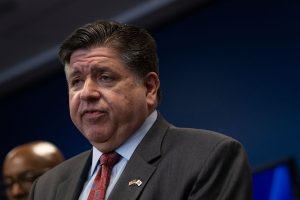
Like a sleazy used car salesman, Illinois Governor JB Pritzker and his Democrat allies are taking a victory lap over the state’s supposedly “balanced” budget. But a quick look under the hood reveals that the Land of Lincoln is far from the model of fiscal responsibility that Pritzker is making it out to be. In reality, the state is barreling toward disaster – and Democrats are trying to sell a lemon of a state as a model of good governance.
Last week, Democrats in Springfield passed a $56 billion spending bill after giving the public precious little time to examine it. The 3,700-page spending plan and implementation bill were introduced late on Saturday, May 30, with about 200 more pages added around 2 a.m. on Monday, June 1. The Senate approved the spending bill after 3 a.m., the House followed at 4 a.m., and Pritzker signed it shortly thereafter. No Republican voted for it.
But despite that shocking lack of transparency, the major headline emerging from the process was that the budget that passed was “balanced.” Pritzker was quick to tout the news on X, posting that “Responsible budgeting in Illinois is now the rule, not the exception.”
“Our eighth consecutive balanced budget focuses on lowering costs and protecting fiscal health,” Pritzker preened. “All the while protecting working families from paying new taxes.”
The activist account “Democrats Deliver” also issued a post congratulating Pritzker, which garnered more than one million views. Fellow Democrat booster “Call to Activism” gushed that Pritzker had “embarrassed” Trump, while left-wing flaks like Harry Sisson gloated that the budget “shatters” the Republican “narrative” about Democrat governance.
But a closer examination reveals that narrative to be entirely intact.
Illinois’s “balanced” budget is not some act of voluntary financial restraint from Pritzker or Democrat legislators. The state constitution requires the legislature to pass a budget in which spending does not exceed estimated funds available for the fiscal year. A balanced budget is therefore not an extraordinary feat. It is the minimum legal requirement.
Nor does “balanced” on paper mean balanced in practice. The state constitution only requires the budget to match whatever amount of revenue lawmakers say they expect to bring in. It does not require a hard, audited, cash-in/cash-out balanced budget in the way that a household would balance a budget.
In other words, the budget actually might not be balanced at all. Democrats have a strong incentive to simply say that the estimated funds available will match the amount they want to spend, even if that estimate has no basis in reality.
There is also another pesky little fact that Pritzker’s “balanced budget” slogan obscures: Illinois remains buried under pension debt that is quickly reaching unsustainable levels.
According to the Illinois Policy Institute, Pritzker’s fiscal year 2027 budget directs about $11.64 billion to Illinois’s five state retirement systems. That satisfies the payment required under a 1995 state funding schedule. But actuaries say the systems need more than $17 billion this year — and every year for the next two decades — to reach full funding and begin reducing the debt. That leaves a roughly $5.4 billion gap between what the law requires and what actuaries say is financially necessary.
Put simply, Illinois is making the minimum payment on a massive credit card balance without showing any signs of actually being able to pay it off.
The five state pension systems were already short $143.5 billion in 2025. That means Illinois has promised far more in retirement benefits than it has saved to pay. The systems had less than 48 cents available for every dollar promised, and Illinois is the only state with a state-managed pension shortfall above $100 billion.
The problem extends well beyond the five state-run systems. A separate Illinois Policy Institute analysis found $493 billion in obligations across 677 state and local government pension plans. Together, those plans had only about 49 cents saved for every dollar promised, leaving a gap of more than $218 billion.
Illinois already spends about $32 million a day on the five state systems alone. Yet even if Illinois put another $1 million toward the broader pension shortfall every day, the institute estimated it would take nearly 600 years to close the gap — without counting new debt added along the way.
A budget that leaves one of the state’s largest long-term obligations billions short is not evidence of fiscal discipline.
A default on pension payments is unthinkable. As Illinois Democrats continue to kick the can down the road, the only solution will be massive, unprecedented tax hikes for residents and businesses already shouldering one of the country’s heaviest tax loads. WalletHub ranked Illinois sixth in the nation for overall tax burden in 2026, estimating that state and local taxes consume 9.92 percent of residents’ personal income.
The 2027 budget already includes new or expanded taxes on social media companies, digital assets, fantasy sports, tobacco, prediction market sports bets, and tires. The budget also lowers the cap on corporate net operating loss deductions, limiting how much businesses can use past losses to reduce their current tax bills.
The social media tax and corporate deduction change alone are expected to generate $500 million. Taxes on digital assets and fantasy sports are projected to raise another $65 million. Despite Pritzker’s claim, these taxes will hit working families, either directly or indirectly – And will do little to eat into the pension systems’ enormous shortfall
The plan also shifts existing revenue to support broader spending. Capitol News Illinois reported that it would redirect $150 million in gas sales tax revenue to the General Revenue Fund once public transportation is fully funded. The budget also adds nothing to the state’s rainy-day fund.
In short, the budget may balance on paper, but Illinois taxpayers are still left with one of the nation’s heaviest tax burdens and pension systems with less than half the money needed to cover their obligations.
Illinois’s “balanced budget” scam is exactly what Americans have come to expect from Democrats nationwide. While the press release sounds good, the reality is something else entirely. Yet liberals like Pritzker seem to believe that saying the right things and making bold statements with no basis in fact amounts to strong leadership.
The only question left is whether enough Illinois voters can see through the smoke-and-mirrors act and recognize the looming disaster in time to avert it.
Sarah Katherine Sisk is a proud Hillsdale College alumna and a master’s student in economics at George Mason University. You can follow her on X @SKSisk76.
