
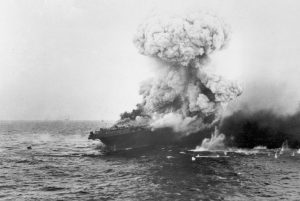
On May 4, 1942, the Battle of the Coral Sea began, marking a pivotal moment in World War II and a turning point in the Pacific theater. Fought between May 4 and May 8, this historic clash between Allied forces—primarily the United States and Australia—and the Imperial Japanese Navy unfolded in the waters northeast of Australia. Though often overshadowed by the Battle of Midway a month later, the Coral Sea engagement fundamentally altered the course of the war.
The battle emerged from Japan’s broader strategy to expand its defensive perimeter and isolate Australia by capturing Port Moresby in New Guinea. Control of this strategic outpost would have threatened Allied supply lines and strengthened Japan’s dominance across the South Pacific. However, Allied intelligence—bolstered by codebreaking efforts—revealed the plan in advance, allowing U.S. Admiral Frank J. Fletcher and his forces to intercept the Japanese fleet.
What followed was unlike any naval battle before it. For the first time in history, opposing fleets never directly sighted or fired upon each other. Instead, the entire conflict was fought through aircraft launched from carriers, signaling a new era of warfare where air power would eclipse traditional battleship engagements.
The fighting was intense and costly on both sides. Japanese aircraft succeeded in sinking the American carrier USS Lexington and damaging the USS Yorktown. Meanwhile, U.S. forces struck decisive blows of their own, sinking the Japanese light carrier Shōhō and heavily damaging the fleet carrier Shōkaku. The loss of aircraft and experienced pilots proved particularly damaging to Japan’s operational strength.
Tactically, the battle appeared inconclusive, with both sides suffering significant losses. Yet strategically, it was a clear Allied victory. The Japanese invasion force targeting Port Moresby was forced to retreat, marking the first time Japan’s advance in the Pacific had been effectively checked. This shift not only protected Australia from immediate threat but also boosted Allied morale at a time when victories had been scarce following Pearl Harbor.
Beyond its immediate outcome, the Battle of the Coral Sea had far-reaching consequences. By damaging key Japanese carriers and depleting their aircrews, it set the stage for the decisive Allied victory at Midway just weeks later. It also demonstrated the growing importance of aircraft carriers, redefining naval warfare for the remainder of the 20th century.
Today, the Battle of the Coral Sea is remembered as more than just a military engagement—it stands as a moment when the tide of war began to turn. On that May day in 1942, amid the vast expanse of the Pacific, the Allies proved that Japan’s seemingly unstoppable advance could be halted, reshaping the trajectory of World War II.
