
Maple syruping is about to start across northern North America, stirring memories of “the old days,” when more people did it, and in less industrial ways. The sap just flows, and soon you have syrup. Well, sort of…
Funny thing is, when this winter started, I was ready for a long one. I wanted deep snow, cold temperatures, and a frozen lake to ice fish and skate on. We still have all that, but…
Many decades ago, growing up in a small Maine town, one of my neighbors liked to make maple syrup. He was the father of a friend. They lived half a mile away, my closest neighbor. Between us was a sugar maple forest.
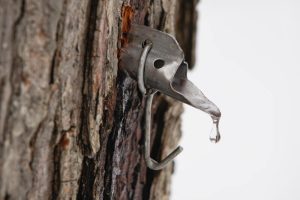
Every year, he would tap the trees. That was done by putting a spile – a small metal spout with a hook into the tree, hanging a covered metal bucket, and waiting. As temperatures rose, usually early March, the sap “ran” and he would empty the buckets, taking the sap to his wood shed.
The shed had big doors, and a well-contained fire was built beside the doors, over which – in those days – a giant kettle was suspended. The sap was put in the kettle and, as it evaporated, it was stirred. The goal was to turn 40 gallons of sap into one gallon of syrup; that’s the ratio.
Now, here is where things get interesting. Nowadays, people use drills, plastic, thermometers, and modern collection and evaporation systems. He had none of that.
My neighbor did this with old spiles, metal buckets, and a big fire – plus constant stirring. Making maple syrup takes hours, days in fact. Having not read my “Adventures of Tom Sawyer,” – where Mark Twain cleverly has Tom convince friends to pay him to paint a fence – I once asked to help.
My friend’s father, who had been stirring quite a while, stood over the hot kettle. He showed me the process. This is where the fault is mine, because seeing how it was done, I wanted to give it a try.
At the start, the aroma of maple sap turning into maple syrup was delicious, like biting into a stack of buttery, syrup-topped pancakes. So, willing to be part of the process, he gave me the stirring stick.
Once he had gone inside, I stirred the kettle vigorously, watched steam rise. For half an hour, this was the greatest fun, like climbing a fire tower for the first time, stacking firewood in early fall.
After about 45 minutes, my friend’s dad came back and asked how I was doing. We never wanted to admit we could not work hard, so I assured him all was good. After an hour, I began to feel queasy. This may seem odd, but maple sap – constantly evaporating and combined with woodsmoke – can make you dizzy. It no longer smells like delicious maple syrup, but more like wet, burned, sweet, dirty socks.
No matter, I was learning how maple syrup is made, being a woodsman, sort of. Eventually, my friend’s dad returned and seemed a bit concerned for me. Having painted enough of the fence, I was glad to be relieved of the stirring stick.
Truth is, I still like maple syrup – a minor miracle, since too much of a good thing can put you off it – but I learned a lot that day. I learned how to make syrup from sap, work hard at it, how hard that is.
Those early lessons never left me. Things that look easy often are not. That wonderful, sweet, amber goo we buy in the store and pour, gingerly – often too gingerly – on pancakes, is really liquid gold. Making it – in the old days – took time, commitment, and stick-to-it-ness, not just in the woods.
Sometimes the thing you are excited about, sure you will just love and not endure, cannot wait to arrive, like heavy snow, cold weather, and a long winter…can lose its appeal. As we shift into spring – and the syrup begins to flow – I think I am about ready for the cold and lake ice to go.
If that sounds unappreciative, not content with all the joys of winter, maybe it’s me. I love the winter, ice fishing, skating, shoveling, and plowing, but there comes a time…when the spring is welcome. And sure as blackflies come out in June, I will be happy for summer, then fall, and winter again.
Until then, enjoy the tail end of a great winter, fish and skate a bit, before God calls it. Go inside, make some pancakes, and enjoy that liquid gold, knowing someone somewhere is tapping sap.
Robert Charles is a former Assistant Secretary of State under Colin Powell, former Reagan and Bush 41 White House staffer, Maine attorney, ten-year naval intelligence officer (USNR), and 25-year businessman. He wrote “Narcotics and Terrorism” (2003), “Eagles and Evergreens” (North Country Press, 2018), and “Cherish America: Stories of Courage, Character, and Kindness” (Tower Publishing, 2024). He is the National Spokesman for AMAC. Today, he is running to be Maine’s next Governor (please visit BobbyforMaine.com to learn more)!
