
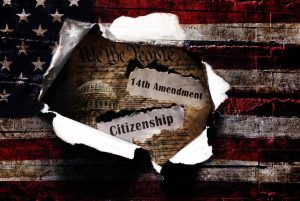
Last week, the U.S. Supreme Court heard oral arguments in Trump v. Barbara, the much-discussed “birthright citizenship” case. Despite the tsunami of news coverage claiming the justices were skeptical of Trump’s position, that was by no means obvious to those of us who actually listened to the argument. The Court could well still rule in Trump’s favor – and such a ruling couldn’t come a moment too soon.
The case specifically centers on the constitutionality of President Trump’s executive order declaring that children of illegal aliens don’t become U.S. citizens simply because they were born within our borders. That order, which Trump issued on his very first day in office, was inevitably denounced by the Democrats and their media mouthpieces as a violation of the 14th Amendment.
But many constitutional scholars disagree with that analysis. As Solicitor General D. John Sauer – the man charged with presenting the administration’s case to the Court – pointed out, the 14th Amendment was ratified in 1868. Its purpose was to overturn the Court’s outrageous Dred Scott v. Sandford decision and confer citizenship on formerly enslaved individuals and their children who had recently been freed after the Civil War. Its citizenship clause reads thus:
“All persons born or naturalized in the United States, and subject to the jurisdiction thereof, are citizens of the United States and of the State wherein they reside.”
Despite countless claims made by the Democrats and the corporate “news” media, this clause was never meant to confer U.S. citizenship on everyone born on our soil. In fact, several exclusions have been universally recognized since the 14th Amendment was ratified, including children of foreign diplomats, children of soldiers from an occupying army, and children born to sovereign Native American tribes.
None of these children are “subject to the jurisdiction” of the United States, and their status is wholly dependent on the legal status of the parent.
This is why the children of illegal aliens cannot be considered “subject to the jurisdiction” of the United States merely because they were born here. Their status is derived from the status of their parents, citizens of other countries who violated the laws of this country to gain entry and remain here unlawfully.
Consequently, as Professor Randy E. Barnett of the Georgetown University Law Center explains in the Wall Street Journal, the entire dispute and the eventual Supreme Court ruling will very likely hinge on the meaning of the “subject to the jurisdiction thereof” clause:
“Opponents of the executive order claim that ‘jurisdiction’ simply refers to the applicability of ordinary civil and criminal laws. They invoke U.S. v. Wong Kim Ark, in which the high court granted birthright citizenship to a man born to Chinese parents. They read Wong Kim Ark and other sources as having incorporated British common-law doctrine, deeming anyone born in the British Empire a subject of the crown.”
The most significant problem with that argument is that Wong Kim Ark’s parents were legal permanent residents – they were not in the U.S. illegally or temporarily. Moreover, the justices in that case defined “jurisdiction” in a way that conflicts with the definition used by the opponents of Trump’s executive order. As Professor Barnett discussed in a separate column written last year for the New York Times:
“In Wong Kim Ark, the leading case on birthright citizenship, the Supreme Court explained that ‘jurisdiction’ referred to being born ‘within the allegiance’ of the sovereign. The Court held that a child born of parents with a ‘permanent domicile and residence in the United States’ was a birthright citizen. Wong Kim Ark’s parents, as persons who came in amity, had entered into the social compact.”
All of which means that the strongest argument advanced by the American Civil Liberties Union (the group leading the opposition to Trump’s order) in last week’s hearing is based on a 1898 case that did not involve illegal aliens and uses a definition for “jurisdiction” that is far broader than the mere application of civil and criminal laws. The term, according to the Court, also meant that Wong Kim Ark owed allegiance to the United States. The ACLU rejected Solicitor General Sauer’s argument that the immigration status of the parents or the political allegiance of the child are relevant.
Sit with that for a moment. The ACLU and the other opponents of Trump’s executive order want to grant birthright citizenship to anyone born within our borders, regardless of whether the parents have entered the country illegally, entered into the social compact, or the children themselves feel any political allegiance to the United States.
Seems crazy, right? Well, that is what the ACLU attorney Cecillia D. Wang argued. But that was not the dumbest thing said in the hearing. That prize goes to Justice Ketanji Brown-Jackson, who posed this ridiculous hypothetical to Attorney Wang:
“I, a U.S. citizen, am visiting Japan. And what it means is that, you know, if I steal someone’s wallet in Japan, the—the Japanese authorities can arrest me and prosecute me. It’s allegiance meaning can they control you as a matter of law. I can also rely on them if my wallet is stolen to, you know, under Japanese law, go and prosecute the person who has stolen it… Is that the right way to think about it?”
Ms. Wang deserves credit for keeping a straight face during this question. Only by the distorted logic of leftism could breaking the law by stealing a wallet be construed as “allegiance” to a country. As The Federalist co-founder Sean Davis pointed out, by that same reasoning, “If I break into your home and steal your jewelry, it means I am a member of your family and entitled to your inheritance.”
Justice Jackson’s commentary was evidently a ham-fisted attempt to legitimize the practice of bestowing American citizenship on a child whose mother, perhaps from somewhere in Asia, happens to give birth during a brief visit to the United States.
This is known as birth tourism and, as Solicitor General Sauer pointed out during Wednesday’s oral arguments, there may be as many as 500 birth tourism companies in China operating to bring pregnant women to the U.S. to create American citizens. According to some estimates, an astonishing nine percent of all births in the United States in 2023 were to illegal aliens or mothers here on temporary status. As AMAC Newsline reported last week, the threat to the United States is literally existential.
This has all inevitably been written off by the corporate media as a conspiracy theory. Yet it was certainly taken seriously by constitutional scholar Jonathan Turley, who told Fox News, “The U.S. is becoming the world’s laughingstock and ‘ship of fools.’ China’s mocking us with hundreds of companies that exist solely to arrange for Chinese citizens to come give birth here!”
The sheer stupidity of birthright citizenship is very real. It clearly wasn’t what the authors of the 14th Amendment had in mind, and SCOTUS needs to put a stop to it immediately.
David Catron is a Senior Editor at the American Spectator. His writing has also appeared in PJ Media, the American Thinker, the Providence Journal, the Catholic Exchange and a variety of other publications.
