
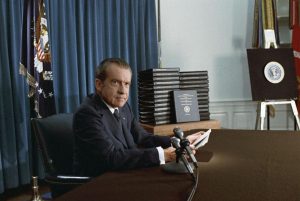
On April 29, 1974, President Richard Nixon addressed the nation in a pivotal moment of the Watergate scandal, announcing that he would release edited transcripts of secret White House tape recordings. The decision came under mounting legal and political pressure, as investigators sought evidence tied to the 1972 break-in at the Democratic National Committee headquarters and the subsequent cover-up by members of Nixon’s administration.
The tapes themselves had been recorded between 1971 and 1973 through a secret taping system installed in the Oval Office and other locations. Their existence was revealed during Senate hearings in 1973, instantly transforming the Watergate investigation. What had begun as a burglary inquiry quickly escalated into a constitutional crisis, with the recordings seen as potentially definitive proof of presidential involvement in wrongdoing.
By April 1974, a special prosecutor and the House Judiciary Committee had issued subpoenas demanding access to dozens of these tapes. Rather than surrender the original recordings, Nixon chose a middle path. In his televised speech, he announced that he would release transcripts of 46 conversations—more than 1,200 pages of material—arguing that they contained all relevant information while protecting sensitive national security details and the principle of executive privilege.
At first, Nixon’s move appeared to be a gesture of transparency, and some observers hoped it might ease the growing crisis. But as the transcripts became public, they had the opposite effect. The documents revealed not only discussions related to Watergate, but also the tone and language used within the White House. Passages marked “expletive deleted” became infamous, highlighting the blunt and often crude nature of the conversations. Rather than restoring confidence, the release deepened public mistrust and intensified scrutiny of the president.
Equally significant was what Nixon refused to provide. By withholding the actual audio recordings, he fueled suspicion that the transcripts were incomplete or selectively edited. The House Judiciary Committee rejected the transcripts as insufficient, insisting on access to the original tapes. The legal battle that followed would culminate in a landmark Supreme Court decision in July 1974, which unanimously ordered Nixon to turn over the recordings.
The April 29 announcement marked a turning point in the Watergate saga. What Nixon intended as a controlled disclosure instead accelerated the unraveling of his presidency. As more evidence emerged—including the so-called “smoking gun” tape—political support for Nixon collapsed. Facing near-certain impeachment and removal from office, he resigned just months later, on August 9, 1974.
Today, Nixon’s decision to release the Watergate tape transcripts stands as a defining episode in American political history. It underscored the limits of presidential power, the importance of accountability, and the enduring role of transparency in a democratic system—lessons that continue to resonate decades later.
