
As the United States approaches its 250th birthday, perhaps the most concerning trend facing the nation is that one side of the political aisle increasingly appears to be losing faith in the American experiment.
A new poll out from survey firm Cygnal earlier this month shows that Democrats have a stunningly negative view of the country. 1,500 voters were asked this question: “After 250 years as a nation, do you believe the United States continues to be a force for good in the world?”
In response, only 26 percent of self-identified Democrats said the United States is a force for good, while 69 percent said the United States is not a force for good. Broken down even further, just eight percent of Democrats said the United States is “definitely” a force for good, 18 percent said the country is “probably” a force for good, 32 percent said “probably not” a force for good, and 37 percent said “definitely not” a force for good.
The polar opposite response from Republicans effectively captured the stark political divide that exists on basic questions of what America is and what she represents in the world. 91 percent of Republicans said that the United States is a force for good, while just seven percent said, “not a force for good.” A solid supermajority of 69 percent of Republicans said the United States is “definitely” a force for good. Just two percent of Republicans said the country is “definitely not” a force for good.
In total, Democrats were net negative in their view of America by 43 points, while Republicans were net positive by 84 points. Independents were exactly split on the issue – 47 percent each said, “force for good” and “not a force for good.”
This poll question is noteworthy because it reflects a divide in American culture that runs deeper than politics. Most pollsters ask about respondents’ outlook on the country at that moment in time. Unsurprisingly, Republicans generally have a favorable outlook on things when a Republican is in the White House, while Democrats generally have a pessimistic outlook. When a Democrat is president, the party-specific polling data reverses.
But the Cygnal poll probes Americans’ view of the country as a whole – our history, our values, our culture, and everything in between. It is ultimately a question about patriotism.
Gallup’s long-running data show that Cygnal did not uncover a one-cycle mood swing. At the start of this century, partisan gaps in national pride were far smaller.
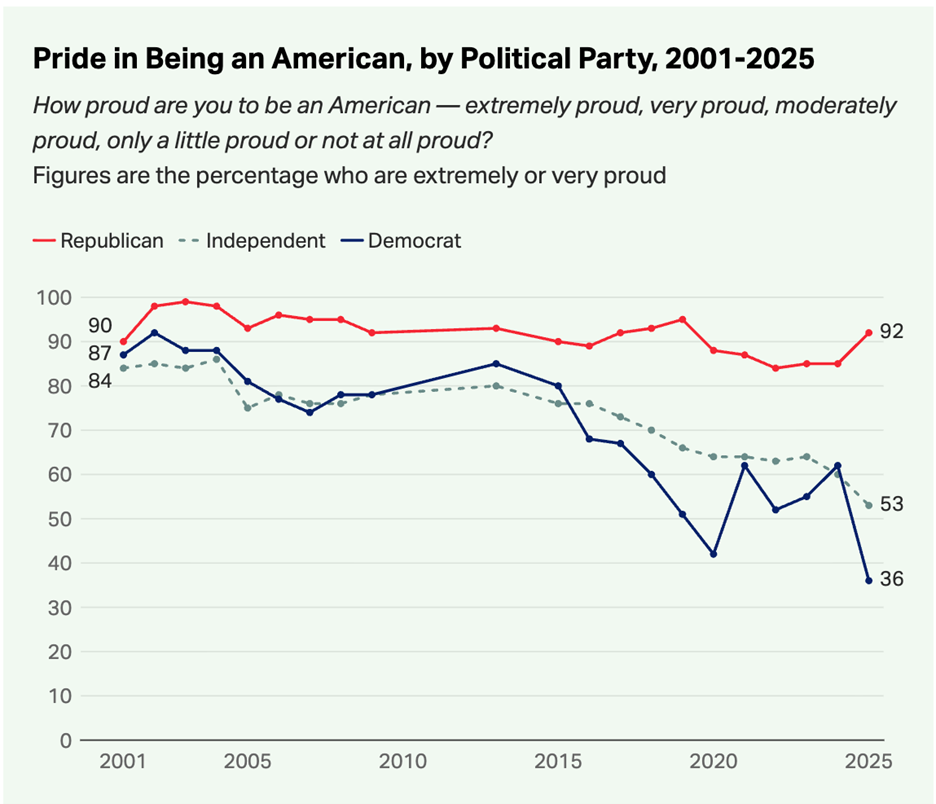
In 2001, 87 percent of Americans overall said that they were “extremely proud” or “very proud” to be an American. People might have still disagreed on tax policy, immigration, and welfare spending, but everyone could at least agree that they loved this country and loved being a citizen of it.
By 2025, that percentage had slipped to 58 percent – a 33 percent decrease over 24 years.
However, Gallup’s party breakdown of the data shows that the decline has been entirely driven by a collapse in patriotism among Democrats. In 2001, 90 percent of Republicans said they were proud to be an American. In 2025, that percentage was even higher, at 92 percent.
Even during Democrat presidencies, large supermajorities of Republicans consistently said they were proud to be an American. The lowest percentage that Gallup ever recorded was 84 percent in 2022, during the depths of the inflation and border crises under Joe Biden.
Democrats, meanwhile, have consistently become less patriotic. 87 percent said they were proud to be an American in 2001. By 2025, that figure had cratered to an astonishing 36 percent.
Even during the Obama years, the percentage of Democrats expressing pride in being an American only ticked up slightly, from 78 percent in 2008 to 85 percent in 2013 before falling again to 80 percent in 2015 and 68 percent in 2016.
Concerningly, patriotism has also fallen sharply among Independents, from 84 percent saying they are proud to be an American in 2001 to just 53 percent in 2025.
Taken together, these poll results reveal something that should be alarming to every American who cares about the future of the country. Large numbers of Democrats, who make up about half of elected officials and half of the electorate, now cannot bring themselves to affirm the basic patriotic judgment that the United States, despite all her flaws, has been and remains a force for good.
There are many causes for this crisis of patriotism. The public education system has been indoctrinating American students to hate their own country for decades. The university system has been even worse. Corporate media outlets like The New York Times have given a platform to anti-American, ahistorical propaganda like the “1619 Project.” Hollywood and pop culture have demonized the founding generation, made slavery and racism the central theme of America’s story, and sowed division and hate to push a political agenda.
Meanwhile, establishment politicians incessantly apologize for America and refuse to assert the moral high ground in international affairs. This has been a problem in both parties, but Republicans have increasingly pushed out these bad actors since President Donald Trump began overhauling the party in 2016.
Regardless of the causes, the reality is that once conviction in the goodness of America collapses, people stop treating their national history and legacy as an inheritance to preserve. They stop making the sacrifices and investments necessary to build a better future.
From a political perspective, voters should also understand that the Democrat Party’s central ethos is now disdain for the country they want to govern. How can any American trust Democrats to defend the interests of a country that most of them can’t even say is a force for good? A party that thinks this way will struggle to uphold the most basic duties of a national government — defending borders, teaching history honestly, honoring military service, projecting confidence abroad, or asking citizens for sacrifice at home.
The silver lining is that voters appear to recognize this fact. The same Cygnal poll found that only 11.1 percent of voters say Democrats have a “clear, compelling vision for the country.” Far more, 40.1 percent, say Democrats are “mostly focused on opposing Trump rather than offering solutions.” That’s not a recipe for long-term electoral success.
Patriotism does not require pretending America is perfect, nor does it require ignoring the stains on the nation’s past. But denying the objective truth that, on balance, America has been and remains a force for good in the world represents a level of delusional self-hatred that is toxic to any democratic society.
If America is to survive another 250 years, her people – no matter their political persuasion – must rebuild and maintain broad public confidence in her inherent goodness.
Sarah Katherine Sisk is a proud Hillsdale College alumna and a master’s student in economics at George Mason University. You can follow her on X @SKSisk76.

