
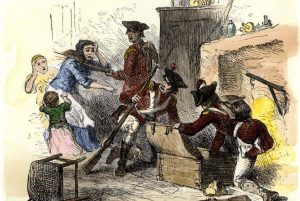
On June 2, 1774, the British Parliament completed passage of the Quartering Act, the final measure in a series of punitive laws collectively known as the Coercive Acts, or the “Intolerable Acts” as they came to be called in the American colonies. Enacted in response to the Boston Tea Party of December 1773, these measures were designed to reassert British authority over Massachusetts and punish colonists for their growing resistance to imperial rule. Instead of restoring order, however, the Coercive Acts intensified colonial outrage and accelerated the movement toward the American Revolution.
The Quartering Act required colonial authorities to provide housing and accommodations for British troops stationed in America. While earlier versions of the law had focused primarily on the use of inns, taverns, and unoccupied buildings, the 1774 act expanded the locations where soldiers could be housed if suitable barracks were unavailable. Although it did not explicitly authorize troops to occupy private homes, many colonists viewed the law as a direct threat to their property rights and personal liberties. To them, the presence of a standing army among civilians symbolized government oppression rather than protection.
The Quartering Act was only one part of a broader British strategy to discipline Massachusetts. Parliament had already passed the Boston Port Act, which closed the port of Boston until the East India Company was compensated for the tea destroyed during the Boston Tea Party. The Massachusetts Government Act sharply curtailed local self-government, placing greater control in the hands of royal officials. Another measure, the Administration of Justice Act, allowed British officials accused of crimes in the colonies to be tried elsewhere, raising fears that royal authorities could evade accountability.
Taken together, these laws convinced many colonists that Britain intended to strip them of their traditional rights as English subjects. What had begun as a dispute over taxation and representation increasingly became a struggle over self-government and liberty. Colonists across North America rallied in support of Massachusetts, viewing the Coercive Acts as a threat to all the colonies rather than a punishment directed at Boston alone.
The response was swift and far-reaching. Colonial leaders organized committees of correspondence, encouraged economic boycotts of British goods, and called for greater intercolonial cooperation. Later in 1774, delegates from twelve colonies convened at the First Continental Congress in Philadelphia to coordinate resistance and petition the Crown for redress. These efforts marked a significant step toward colonial unity and laid the groundwork for the revolutionary movement.
The completion of the Quartering Act on June 2, 1774, represented far more than a logistical measure concerning military housing. It became a powerful symbol of British overreach and helped galvanize opposition throughout the colonies. By attempting to tighten imperial control, Parliament instead deepened colonial resentment and moved Britain and its American colonies one step closer to war.
