
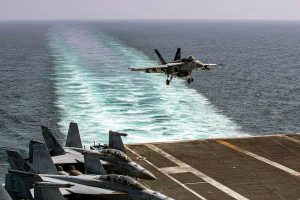
This weekend, the U.S. and Israel began a series of military strikes on Iran as part of “Operation Epic Fury” that killed Iranian Supreme Leader Ayatollah Ali Khamenei and other high-ranking officials and severely damaged Iran’s military capabilities. The Iranian counterattack has killed three American service members and seriously injured at least five more.
Amid all the chaos that has unfolded over the past 48 hours, that is the upshot of what we know so far. There’s plenty of speculation, and a cacophony of opinions has flooded the airwaves. But in this moment, the best approach may be taking stock of what we know for sure, and praying hard – for our troops, for their families, for our leaders, and for the civilians caught in harm’s way.
Here’s something else we know: President Trump has been honest that there will likely be more American casualties as the attacks continue this week, but he has also stated his firm belief that this is an operation that is in the best interests of America and neutralizes a serious threat to U.S. national security.
Many Democrats and even some Republicans are criticizing the Trump administration for Operation Epic Fury. And Americans are indeed justified if they are wary of becoming embroiled in another Middle East “forever war.” But the Trump record has been such that Americans would do well to trust that there is indeed a thorough and carefully crafted plan – and that it will be successful. Moreover, Trump has proven time and again that his number one priority in any armed conflict is getting in and out as quickly as possible and going to extreme lengths to avoid American casualties.
Reason for trust comes first from Trump’s now decade-long record of confounding the predictions of the foreign policy establishment.
During his first term, the “experts” were convinced that Trump’s verbal sparring with Kim Jong Un meant that the U.S. was headed to war with North Korea. Similarly, the commentariat class predicted that Trump’s 2020 strike on Iran’s most powerful military leader, Qasem Soleimani, would mean broader war in the region – much like they are predicting now. Instead, it helped lead to a period of relative quiet.
In the first year of this second term, we have been treated to similar doomsaying about the U.S. operation capturing Venezuelan President Nicholas Maduro. Rep. Gregory Meeks (D – NY) said after the capture that “using the US military to attempt regime change in a sovereign foreign nation, without approval from Congress, without a defined objective or plan for the day after, and without support from our allies, risks entangling the United States in an open-ended conflict in Venezuela that could destabilize the entire region.”
Sen. Mark Kelly (D – AZ) made the same criticism of President Trump this weekend, claiming that, because President Trump mentioned “hope” several times, this indicates absence of strategy. “Hope is not a strategy,” Kelly told Meet the Press. “We’ve got to have a plan here. I mean, what is the strategic goal? And how do we achieve it?”
But the fact that Trump has not shared his strategy with Trump-hating politicians like Kelly is not evidence that he has no strategy. One of the reasons our Constitution makes the president commander-in-chief is that congressional debates over strategy would result in endless gridlock where speed and decisiveness are necessary.
In any case, Trump keeps proving his critics wrong. We never went to war with North Korea. It’s been two months since the capture of Maduro, and there is no evidence of an open-ended destabilizing South American war.
But Kelly wasn’t finished with his bad-faith attacks on the President. “We saw in Iraq that in 2006, Saddam Hussein was finally killed. And then over more than a decade, we lost 1,500 Americans,” he said. “I don’t want to see a wide conflict in the Middle East.”
Kelly’s claim here is that the killing of Ayatollah Khamenei is by default the beginning of yet another “forever war.” His evidence for this is that the last time the United States took out the leader of a Middle East nation, it led to a long and unpopular war.
But Trump is not George W. Bush, Iran is not Iraq, and this is not 2006. A more compelling argument is that Trump is doing something very different from the forever war strategy. His plan is not about starting a new conflict. He wants to bring out into the open and end a conflict with the Islamic Republic of Iran that has been raging for decades even if some American politicians have been reluctant to acknowledge it.
Those claiming that the U.S. strikes on Iran do not meet the “just war” standard ignore five decades of Iran undermining American interests and maiming and murdering American citizens. They kidnapped Americans when they seized the American Embassy in Tehran in 1979. They were behind the 1984 Beirut Embassy bombing by Hezbollah. They were behind Hezbollah’s 1995 Khobar Towers bombing that killed Americans.
The Iranian regime was also helping terrorists in Iraq and Afghanistan during those forever wars we were mired in. They were behind a 2023 drone strike in Syria that killed five American service members and a contractor, as well as a 2024 drone attack that killed three service members in Jordan and injured 40 more. They were behind the October 7, 2023, attacks in which Hamas killed more than 1,200 people and took 254 hostages in Israel. 46 American citizens were killed and 12 were taken hostage in that action.
If this brief stroll down memory lane isn’t enough, journalist Steve Guest has compiled a list of more than 50 “examples of Iran hurting America and terrorizing the world.” Iran’s infamous chant of “death to America” has been backed up by plenty of action.
Those who argue that Iran isn’t the biggest threat to the United States should also consider the possibility that this weekend’s strikes were about positioning the United States in its ongoing competition with China and Russia as well. J. Michael Waller of the Center for Security Policy noted that the U.S. and Israel’s destruction of the Kharg Island power plant “cut off a substantial chunk of the Chinese Communist Party’s heavily discounted foreign oil.” We know China is irate, in part because, as Fox News reported, while Iranians in America are celebrating the death of Khamenei, a Chinese tycoon named Neville Singham is funding the protests opposing America’s military action.
With regard to Russia, all those still making the absurd claim that Trump is “Putin’s puppet” should observe how quickly Ukraine came out in support of Operation Epic Fury. In a very long post on X, President Zelenskyy wrote: “Although Ukrainians have never threatened Iran, the Iranian regime has decided to side with Putin and supply him with ‘Shahed’ drones—not just the drones themselves, but the technology. Iran has also provided Russia with other weapons.”
In other words, Trump’s action to extinguish Iran’s terrorist regime could also erode the military capabilities of Tehran’s allies in Moscow and Beijing.
It is fine to be nervous about this conflict. It is serious business. As Americans, we ought to both pray for our leaders and our troops, while holding the leaders to account. We will do so even for President Trump. The history, the logic, and the early results of this action, however, suggest that trusting that there is indeed a Trump plan that is both comprehensive and good is the best approach for now.
David P. Deavel teaches at the University of St. Thomas in Houston. A past Lincoln Fellow at the Claremont Institute, he is a Senior Contributor at The Imaginative Conservative. Follow him on X (Twitter) @davidpdeavel.
