
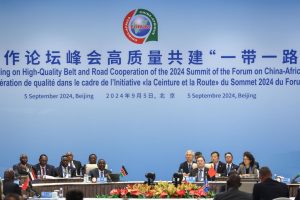
China is no longer content to dominate trade routes on land and sea. It is now extending that model into orbit. What Beijing calls commercial development beyond Earth’s atmosphere looks increasingly like a strategic architecture designed to challenge the United States.
China’s modern “Belt and Road” initiative, sometimes referred to as the New Silk Road, is presented as a global development program built on infrastructure, trade, and investment. But in practice, it has functioned as a tool of geopolitical leverage. Countries that accept Chinese financing frequently find themselves locked into opaque contracts, burdened by debt, and dependent on Chinese technology and standards.
The model is simple and ruthless. Beijing builds influence by embedding itself into the critical systems of partner nations, all while maintaining the outward appearance of mutual benefit.
That same model is now being replicated in space. What could be described as a “Space Silk Road” extends beyond satellites and launches into a network of ground stations, tracking facilities, and data systems that bind participating countries to China’s technological ecosystem.
Beneath the rhetoric of scientific cooperation lies a dual-use infrastructure that serves both civilian and military purposes. The result is a growing web of capabilities that enhances China’s intelligence collection, communications resilience, and potential wartime readiness.
Recent developments underscore how quickly this effort is accelerating. China has demonstrated a floating launch platform in the South China Sea and robotic systems capable of in-space refueling, technologies that could enable rapid satellite replacement during conflict. Its space station hosts engineers working on communications, artificial intelligence, and other technologies with clear military applications.
These advances are not occurring in isolation, but are part of a broader push to integrate space power into China’s strategic doctrine.
Africa offers a clear illustration of how this approach works in practice. China’s construction of the Telecom Earth Station in Windhoek, Namibia, linked to a tracking station in Swakopmund, connects directly to its satellite command infrastructure. While publicly framed as a high-tech development project, the system feeds into a global network that can monitor satellites and support missile-related operations.
Beijing’s ambassador to Namibia, Zhao Weiping, presented the station as Beijing’s “first high-technology development and assistance project” in the country. But as Professor Suen Yong, a Chinese dissident and a high-ranking CCP official before his defection to the West, told me, “He spoke truthfully, but avoided specifying who truly benefits from this project – the Chinese military.”
Similar patterns appear across the continent. Tunisia hosts a BeiDou Navigation Satellite System center, providing an alternative to American GPS. Ethiopia’s Entoto Observatory includes Chinese-built ground station capabilities. Nigeria operates control systems tied to Chinese satellites. Each project deepens technical dependence and expands Beijing’s operational reach.
The same dynamic is unfolding in North Africa and the Middle East. China has launched satellites for Algeria and Egypt and helped establish Egypt’s Satellite Assembly, Integration, and Test Center in Cairo, a hub for remote-sensing technology. These facilities are nominally civilian, but their data and infrastructure have clear military utility. Over time, they create what analysts describe as “technical lock-in,” making it difficult for host countries to shift away from Chinese systems without significant cost.
Latin America presents an equally concerning picture. According to recent reporting, China has secured access to nearly a dozen space-related facilities across Argentina, Bolivia, Brazil, Chile, and Venezuela. These sites are often staffed by personnel linked to the People’s Liberation Army and provide data that can support missile tracking, electronic warfare, and secure communications.
In Argentina, the Espacio Lejano Station – a joint project with China – features a massive antenna capable of monitoring satellites across large portions of the Western Hemisphere. Another Argentine site, the Felix Aguilar Satellite Laser Ranging station, contributes precision data useful for targeting and reconnaissance. A U.S. Senate report called it “Latin America’s most active geodetic site.”
These installations are consistently described as scientific or commercial ventures. Yet their capabilities suggest otherwise. Secure communications, telemetry, and tracking systems are foundational elements of modern military operations, particularly in space-based conflict scenarios. By dispersing these assets globally, China gains redundancy, reach, and resilience.
The intent behind this strategy has been articulated, at least in part, by insiders and analysts. An anonymous PLA dissident described a worldview in which conflict with the United States is not hypothetical but assumed, echoing earlier guidance to adopt a “capitalist façade” while pursuing long-term strategic competition.
Analysts have similarly pointed to China’s goal of establishing “strategic presence and technical lock-in,” noting that satellite infrastructure fosters lasting dependence. Others emphasize that these investments “institutionalize long-lasting relationships,” embedding China deeply within the operational systems of partner nations.
A previous case demonstrates that these ostensibly civilian projects can evolve into something far more concerning – and that they can be stopped. In 2013, Huawei, the Chinese Academy of Sciences, and the Technical University of Federico Santa Maria established an astronomy research center in Valparaíso, Chile. China later converted the site into a high-precision tracking and signal collection center, with the assignment of Dr. Jing Liu, a scientist tied to a PLA satellite engineering unit, confirming its military purpose.
In 2023, U.S. Ambassador Bernadette Meehan informed Chilean authorities that the facility was tracking satellites and collecting military-relevant data in violation of its agreement. The following year, sustained diplomatic pressure led Chile to cancel the project. The episode offers a rare but important lesson: China’s space infrastructure is not immutable, but countering it requires early recognition and sustained engagement.
China’s expanding space infrastructure in Africa and Latin America is not an isolated phenomenon. It is the logical extension of a strategy that blends economic inducement with strategic positioning. By building and controlling key nodes in global space architecture, Beijing is positioning itself to influence, monitor, and potentially disrupt critical systems far beyond its borders.
The question is no longer whether China is pursuing a Space Silk Road. The evidence suggests it already is. The more pressing question is whether the United States and its allies are prepared to respond before that network becomes too entrenched to challenge.
Ben Solis is the pen name of an international affairs journalist, historian, and researcher.
