
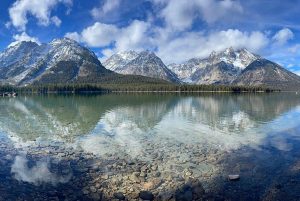
On February 26, 1929, a defining moment in the American conservation movement took place when Congress officially established Grand Teton National Park in northwestern Wyoming, preserving one of the most spectacular mountain landscapes in the United States for the enjoyment and benefit of future generations. The park’s creation reflected both a growing national appreciation for wilderness preservation and a complex clash of local interests, federal policy, and private philanthropy.
Located south of Yellowstone National Park, the Teton Range had long captivated explorers, scientists, and outdoor lovers with its dramatic peaks, pristine lakes, and rugged valleys. Early discussions about protecting the Tetons dated back to the late 19th and early 20th centuries, when conservationists proposed expanding Yellowstone’s borders to include the nearby mountains. Although those early efforts failed, they laid the groundwork for a later push to set aside a separate national park.
By the 1920s, rising automobile tourism and increased public interest in the West’s natural beauty drew greater attention to the Tetons. Advocates sought to protect the area from commercial development and unregulated exploitation. After years of lobbying and debate, Congress passed legislation signed by President Calvin Coolidge establishing Grand Teton National Park. The original park, encompassing roughly 96,000 acres, included the iconic Teton peaks and the glacial lakes at their bases, such as Jenny and Leigh Lakes.
While the park’s creation was a victory for conservation, it was far from a smooth process. Local ranchers and residents of Jackson Hole — the valley at the foot of the Tetons — were initially resistant to federal control of the land, fearing restrictions on grazing, development, and traditional uses of the landscape. As a result, the park’s initial boundaries excluded most of Jackson Hole, limiting it to the rugged uplands and protecting only a narrow strip of scenic terrain.
Behind the scenes, philanthropist John D. Rockefeller, Jr., played a pivotal role in the park’s expansion. Beginning in the late 1920s, he quietly purchased thousands of acres in Jackson Hole through the Snake River Land Company with the goal of eventually donating the land for federal protection. This effort sparked controversy among locals who resented “eastern money interests” influencing Western land policy, but it ultimately proved crucial to the park’s growth.
In 1943, President Franklin D. Roosevelt used the Antiquities Act to create the adjacent Jackson Hole National Monument, incorporating many of Rockefeller’s donated lands. After years of political negotiation and shifting public opinion, Congress united the monument and the original park in 1950, creating much of the modern Grand Teton National Park known today.
Today, Grand Teton National Park protects more than 300,000 acres of rugged mountains, pristine lakes, and abundant wildlife. It stands as a testament to early 20th-century conservation efforts and the ongoing commitment to preserving America’s natural heritage in the face of development and change.
