
Independence Day has passed. The Great American State Fair has now come to a close. But that doesn’t mean there’s nothing left to do in the capital to celebrate America’s 250th birthday. If you’re planning a visit there at any point this year – or looking for an excuse to make the trip – a monument that you’ve probably never heard of is worth the stop.
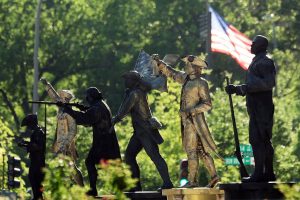
A few blocks from the National Mall, in front of the old Willard Hotel, Freedom Plaza has just reopened after a long-overdue rehabilitation led by the Trump administration. The fountain runs again for the first time in a decade, the plaza is beautiful, and the view down Pennsylvania Avenue to the Capitol building is breathtaking. But the real reason to go isn’t the water or the vista. It’s the twelve men standing watch around the square.
They call the exhibit “Freedom Assembled,” and it’s exactly that: an assembly of the kind of Americans our history books skip past on the way to the famous names. No Washington here, no Jefferson.
Instead, visitors can gaze upon bronze likenesses of a Yale professor (before Yale went woke), a Presbyterian chaplain (before much of Presbyterianism went woke), a 15-year-old farm boy, and several men who fought for a country that did not yet recognize them as equals. They are arranged around a towering equestrian statue of Caesar Rodney — the Delaware delegate who rode eighty miles through a thunderstorm, sick and half-blind with cancer, to cast the vote that broke his state’s tie and helped deliver American independence.
Rodney’s statue was notably torn down in Joe Biden’s hometown of Wilmington, Delaware in 2020 as part of the woke “reckoning.” Even though Rodney introduced the bill prohibiting the import of more slaves into Delaware and freed the slaves he inherited from his father, the left decided that this founding hero must be denigrated and forgotten. But thanks to Trump, this magnificent statue has found a better, more stately home.
When you come, linger with each figure and read what they did. Samuel Whittemore was 78 years old — a grandfather, by any measure retired from soldiering — when he grabbed his old musket and attacked a column of retreating British regulars after Lexington and Concord. They shot him in the face and bayoneted him 13 times, but his will to live was as strong as his love for his country. He lived to the ripe old age of 96.
There’s Simon Knowles, who enlisted at 15, crossed the Delaware with Washington, and endured Valley Forge before going home to farm. Naphtali Daggett, a Yale professor, marched a hundred of his students out to meet two thousand British soldiers rather than let New Haven fall undefended, and paid for it with his life a year later. (Can you imagine a Yale professor leading his students to defend America even just with words today?)
And then there are the men who knew that America’s complicated history with slavery could not overshadow the promise of our new nation. Caesar Glover was sold into slavery in Massachusetts at eight years old and later crossed the icy Delaware with Washington’s army as a free soldier of the Continental line. Peter Salem, James Armistead Lafayette, Jack Sisson, and Salem Poor are also there — all black patriots who fought, spied, and bled for their country.
Off to the side, near the west fountain, stands a smaller and starker monument: a tribute to the men who died aboard British prison ships in New York harbor. More Americans perished on those rotting hulks than died in every battle of the Revolution combined. These men are so often unremembered. They didn’t participate in the great battles in the war. They aren’t often held up as heroes of the founding era. But they suffered in chains for the country they loved, and their sacrifice helped build our great nation all the same.
As we celebrate the 250th birthday of the United States, it’s easy to think back on the great men who launched our experiment in liberty and self-governance, forged our founding documents, and stood on the front line—Washington, Jefferson, Adams, Franklin, Hamilton, and so many others. But if we only focus on the great men, we can easily forget that this nation was also built by—and built for—everyday Americans. Our founders were also the farmers, preachers, freedmen, teenagers, and prisoners who fought, bled, worked, sweated, and even died so that we could still have liberty a quarter millennium later.
So next time you head to Washington, D.C., visit Freedom Plaza. Honor Caesar Rodney. Learn about the twelve men beside him. And say thank you. Our nation would not exist without those men—and it can only continue to exist so long as enough good men and women today commit to emulating them.
Horatius is the pen name of a writer who served in the first Trump White House and on Capitol Hill.
