
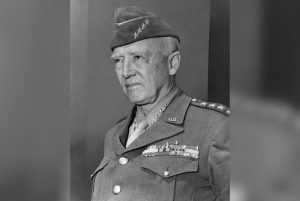
Modern historians underrate George S. Patton, whose military brilliance and courage delivered vital victories in WWII. His gritty personality, love of history, and impolitic eccentricities make him memorable. Two days in his life also stand out.
On March 22, 1945 – this week 80 years ago – Patton and his Third Army crossed the Rhine River, pushing into Germany, where they would liberate concentration camps in April, before the war in the European Theater ended on VE Day, May 8.
Three months earlier, Patton’s brilliance shone. From the movie Patton, many will recall an exchange where Patton declares he can get elements of his Third Army to Bastogne – with men trapped, critical to winning – in three days.
In the movie, George C. Scott, playing Patton, gets a call on December 18 from General Bradley. “Brad, I’ve got a bridgehead across the Saar. I’m on my way into Germany.” Bradley says, “Wait a minute, George, there’s a lot of trouble up north.”
Bradley tells Patton that the Supreme Allied Commander, Dwight D. Eisenhower, needs to meet about the “trouble.” To no one in particular, Patton says, “There is absolutely no reason for us to assume the Germans are mounting a major offensive” to the north. He then adds, “Therefore, I believe that’s exactly what they are going to do.”
In the movie, Patton is asked how long it will take him to turn his massive Third Army “90 degrees” and go north, not east. The assumption is a week or more, Americans were trapped at Bastogne.
Patton will not have it, says: “I can attack with three divisions in forty-eight hours.” Bradley is visibly shocked. Truth be told, Patton did achieve that stunning speed, routed the Germans, but there is more.
While in the movie, it sounds like bravado, for which Patton was famous, reality is different. Patton was intuitive, a good intelligence analyst. He was always thinking ahead, trying to read the enemy.
For one week prior to that ask and bold statement, Patton had been studying the Germans, predicting they might attack – by surprise – up north, where they did. When the moment came, he was ready.
Even in November 1944, a month earlier, Patton noticed the northern sector was quiet, opposite the First Army. Where others saw this as a good sign, Germans tired and fading back, Patton thought it strange.
His diary on November 25 reads: “First Army is making a terrible mistake leaving the VIII Corps static, it is highly probable that the Germans are building up east of them.” He foresaw the attack.
This is exactly what the Germans were doing. Patton did not trust – or depend exclusively on – traditional intelligence, like the famous “Ultra” machine, that British tool for decrypting German messages.
He depended instead on a tight circle of creative, self-contained intelligence analysts. Where others thought the Germans were finished, all worn out, Patton doubted it, saw hints of action north.
So, long story made short, when everyone else thought the war was ending, the enemy exhausted, no options – Patton put nothing by them, and was right. Their push at Bastogne marked the Battle of the Bulge.
Patton’s original thinking – ignoring others, imagining, and “looking around corners” – proved decisive. He was ready when time called.
When he was ordered to bolt and said he could do it in three days, it was not bravado – it was preparation. His Third Army rescued those at Bastogne, stopped the German push to Antwerp, where they would have split the Allies, and sued for peace.
So what does that trait – Patton’s tendency to think ahead, be original, and ignore critics – mean for us today? Maybe not winning wars, but the value of something in short supply: Original thinking.
In an age worshipful of AI and conformity, skeptical of original thought, we could learn from the likes of Patton. Many of America’s best leaders were unapologetically original, unswayed by critics.
As Patton himself wrote, “If everyone is thinking alike, then somebody isn’t thinking.” Perhaps a few more of his best gems fit the moment.
His impolitic – but accurate – thinking produced: “A civil servant is sometimes like a broken cannon, it won’t work, and you can’t fire it” and “The highest obligation and privilege of citizenship is bearing arms.” Those two fit our moment, if any of his observations do.
Considered irreverent, he could be unusually deep. After addressing troops before their amphibious assault on Sicily, he admitted going to his quarters and weeping. He knew many of those American boys would die there.
On the pithy side, he wrote, “The supreme measure of a man is what he would risk his life for.” On success, “Always do more than is required of you.”
Patton, for some, is abrasive, unapologetic for what he thought right, even if wrong; to others, he is brilliant, courageous, a man with hidden talents. Either way, without his original thinking, we might not have won World War II. This week, 80 years ago, his Third Army crossed into Germany. Worth a pause.
Robert Charles is a former Assistant Secretary of State under Colin Powell, former Reagan and Bush 41 White House staffer, Maine attorney, ten-year naval intelligence officer (USNR), and 25-year businessman. He wrote “Narcotics and Terrorism” (2003), “Eagles and Evergreens” (North Country Press, 2018), and “Cherish America: Stories of Courage, Character, and Kindness” (Tower Publishing, 2024). He is the National Spokesman for AMAC. Today, he is running to be Maine’s next Governor (please visit BobbyforMaine.com to learn more)!
