
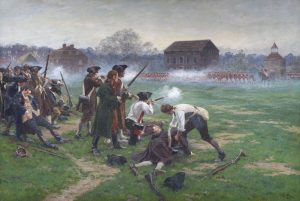
Too often, we forget the events behind our lives, satisfied with less. Now and then, details are worth reviewing, the past worth imagining. On April 19, 1775, a handful of colonial rebels faced British soldiers at Lexington & Concord, freedom’s origin.
In early April 1775, Lexington was a town of 700 and Concord 1400, alive on maps of “The New World” for 140 years. Early settlers built homes here in 1635, 15 years after the Mayflower. Lying roughly 20 miles northwest of Boston, the two towns expanded quickly as trade with Boston grew.
By early 1775, the “Sons of Liberty,” those gritty patriots determined to stop British taxes and tyranny, were 10 years old. History often puts them under “The Liberty Tree,” an elm in Boston.
That tree was memorialized in a poem by Tom Paine, his first verses: “In a chariot of light from the regions of day, The Goddess of Liberty came; Ten thousand celestials directed the way, and hither conducted the dame. A fair budding branch from the gardens above, where millions with millions agree, She brought in her hand as a pledge of her love, and the plant she named Liberty Tree.”
By April 1775, tensions were high. The Boston Tea Party, a theatrical anti-tax revolt, had occurred in 1773. The British responded with five provocative “Intolerable Acts” that punished the colonies. That triggered the formation of militias, leading the British to declare Massachusetts “in rebellion.”
By April 1775, the British knew these colonial militias had been formed. General Gates knew they were stockpiling munitions around Lexington and Concord. He went after them with 1,500 regulars, the vanguard of which was 700 soldiers who met by 77 colonial “Minutemen” at Lexington.
In truth, the colonial rebels had known for weeks – with effective counterintelligence – that Gates might come, so they had moved their stockpiles. They did not invite the conflict, but were ready for it.
When the first shots were fired at Lexington, eight colonial “Minutemen” or militia members died. The British pressed for Concord, where they met furious resistance, leading some 4,000 colonial rebels to rout 1,500 British regulars, and eventually encircle Boston. The war had begun.
While historians – and proud members of the two towns, Lexington and Concord – have long disputed whether the Revolutionary War began in one town or the other, the day is enshrined as “Patriots’ Day,” and it plainly represents the start of armed resistance to British oppression.
So, looking back on our “freedom’s origin,” this month – these days of early April, ice receding from local ponds and spring in the air – were filled with tension in 1775. That tension exploded into conflict, lit the Revolutionary War, which gave rise to America, our freedom, and many blessings.
Those events also inspired Ralph Waldo Emerson’s famous “Concord Hymn,” with the line about the “shot heard ‘round the world,” written in 1837 and put on “The Minuteman” statue in Concord.
Emerson’s poem, in full, reads:
“By the rude bridge that arched the flood,
Their flag to April’s breeze unfurled,
Here once the embattled farmers stood,
And fired the shot heard round the world.
The foe long since in silence slept;
Alike the conqueror silent sleeps;
And Time the ruined bridge has swept
Down the dark stream which seaward creeps.
On this green bank, by this soft stream,
We set to-day a votive stone;
That memory may their deed redeem,
When, like our sires, our sons are gone
Spirit, that made those heroes dare
To die, and leave their children free,
Bid Time and Nature gently spare
The shaft we raise to them and thee.”
Freedom, of course, is easy to write about – harder to defend. But if that was the beginning, let there be no end. As April’s warm winds blow in, we should love America’s freedom and its origin, celebrate it, and recall again the Minutemen.
Robert Charles is a former Assistant Secretary of State under Colin Powell, former Reagan and Bush 41 White House staffer, Maine attorney, ten-year naval intelligence officer (USNR), and 25-year businessman. He wrote “Narcotics and Terrorism” (2003), “Eagles and Evergreens” (North Country Press, 2018), and “Cherish America: Stories of Courage, Character, and Kindness” (Tower Publishing, 2024). He is the National Spokesman for AMAC. Today, he is running to be Maine’s next Governor (please visit BobbyforMaine.com to learn more)!
