
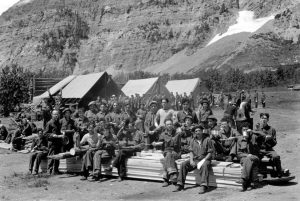
On March 31, 1933, under President Franklin D. Roosevelt, the Civilian Conservation Corps (CCC) was established and became one of the most ambitious and impactful programs of the New Deal, created in response to the twin crises of the Great Depression: widespread unemployment and environmental degradation. Designed as a work-relief initiative, the CCC aimed to provide jobs for young men while simultaneously restoring and conserving the nation’s natural resources.
At its core, the CCC offered employment to millions of unemployed, unmarried men, typically between the ages of 18 and 25. These enrollees, often called Roosevelt’s “tree army,” were stationed in camps across the country, where they lived under structured conditions and worked on a wide range of conservation projects. For many participants, the program provided not only a steady income but also food, shelter, and a renewed sense of purpose during a time of economic uncertainty.
The work carried out by the CCC left a lasting mark on the American landscape. Enrollees planted billions of trees, built trails and park facilities, constructed roads and bridges, and implemented erosion and flood control measures. Much of this work took place in national and state parks, where CCC crews helped develop infrastructure that is still in use today. Their efforts played a critical role in shaping the modern park system and expanding public access to the outdoors.
In addition to its environmental impact, the CCC provided vital economic support to families during the Depression. Participants earned a monthly wage, a significant portion of which was sent directly home, helping to sustain households and stimulate local economies. The program also emphasized education and job training, offering classes in literacy, vocational skills, and other subjects that improved enrollees’ future employment prospects.
The CCC operated with a unique structure that blended civilian labor with military organization. While it was not a military program, the U.S. Army played a key role in managing camps, transporting workers, and maintaining discipline. This approach allowed the CCC to mobilize quickly and operate efficiently on a national scale, ultimately employing more than three million men during its existence.
Despite its successes, the program reflected the social inequalities of its time. Opportunities were largely limited to young men, and racial segregation was common within the camps. Even so, the CCC remained widely popular and is often remembered as one of the most successful New Deal initiatives.
The program came to an end in 1942 as World War II created new employment opportunities and shifted national priorities. Yet its legacy endures in the forests restored, parks developed, and infrastructure built by its workers. More broadly, the CCC demonstrated how government action could address economic hardship while promoting environmental stewardship, leaving a lasting imprint on both the nation’s landscape and its history.
