
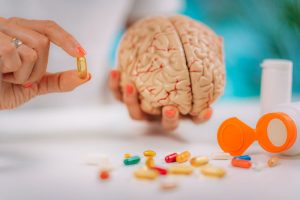
Nootropics
Brain supplements, also known as nootropics, are a category of supplements or drugs linked with beneficial effects on the brain. They may also be called brain boosters, memory enhancers or smart drugs. Some people add dietary supplements to their regimen to improve brain health. While they may help, they do not have the same strict requirements as prescription medications do. Always consult a doctor before adding supplements to the diet.
People may take nootropics to:
- Boost Memory
- Increase alertness
- Improve creativity
- Help with motivation
- Support general cognitive function
- Reduce age-related declines of the brain
Dietary supplements are available in many forms to include:
- Pills
- Gummies
- Powders
- Liquids
- Bars
Consult your physician
Dietary supplements, even those for brain health, are not intended to treat, diagnose, prevent or cure diseases. While nootropics may be helpful for the brain, over-the-counter products are not miracle cures. It is sometimes hard to tell if dietary supplements are safe and effective. A medical doctor can guide your decisions based on recent medical studies, your personal health profile, and potential benefits or drawbacks of supplements.
Why consider nootropics?
As we age, our brains experience gradual changes. Per WebMD, the brain starts to get smaller in your 30s and 40s and shrinkage speeds up around age 60. “On top of less mass, older brains tend to get less blood flow, and the connections between nerve cells slows.” Some older adults may experience minor declines in attention, memory, and learning new information like a foreign language. While it’s entirely normal for older people to experience non-serious occasional memory slips, such as forgetting where they left their car keys, more serious or frequent episodes of memory loss should be medically addressed.
Are nootropics safe?
Nootropic supplements are generally well-tolerated by people. However, as with most supplements, there is a potential for side effects, drug interactions, and addiction, so folks should talk to their doctor to see what’s right for them.
Are brain supplements effective?
In terms of effectiveness, Healthline shares, “More human research is still needed to confirm the benefits and safety of most nootropic supplements. None are FDA-approved for brain function.” Despite this, limited research shows that some products have the potential to benefit the brain. For instance, Per Healthline, creatine, fish oils and ginkgo biloba show promise as helpful brain supplements.
Creatine
Creatine is a popular supplement for brain health. People mainly take it to help improve thinking and memory skills. In addition to supplements, creatine can be found in foods like red meat, poultry, fish and eggs. Creatine is a naturally occurring compound that is produced in the body by the liver, kidneys, and pancreas. Though primarily stored in the muscles to be used for energy, a small amount (about 5 to 10 percent) is in the brain. Per University Hospitals, some studies suggest that increasing the brain’s supply of creatine can help rid people of fatigue, improve mood, and enhance short-term memory and reasoning.
Fish oils
Fish oils are another common supplement for brain health. Fish oil is the fat (oil) that’s extracted from the tissue of fish like tuna, salmon, trout, herring, and others. Per Prevention, fish oil is rich in omega-3 fatty acids usually in the form of docosahexaenoic acid (DHA) and eicosapentaenoic acid (EPA), vitamin A and vitamin D. “Your brain is made up of nearly 60% fat and much of this fat is omega-3 fatty acids. Therefore, omega-3s are essential for typical brain function.”
Ginkgo biloba
Ginkgo biloba is referred to as a living fossil because the tree has been around for over 200 million years. Per Vision and Eye Health, “The real power of ginkgo biloba comes from its leaves, which are packed with bioactive compounds such as flavonoids and terpenoids.” As part of a series of benefits related to cell protection, it is believed that the supplement can support brain health by improving mental clarity, fighting off brain fatigue, and boosting cognitive function.
Read labels carefully
Creatine, fish oils, and ginkgo biloba are ingredients that are commonly found in popular nootropic supplements. Some vitamins, minerals and other ingredients like ashwagandha and ginseng may also be marketed as beneficial for brain health. However, it’s essential to consult a doctor to learn which supplements are recommended for your individual health needs and inquire about proper dosage to gain health benefits while avoiding consequences.
FDA’s limited role
Food and Drug Administration (FDA) regulates dietary supplements differently than prescription drugs. For instance, dietary supplements do not require FDA approval prior to marketing. This leaves the potential for misbranded or adulterated supplemental products. People buying nootropics are encouraged to stick with reputable manufacturers that adhere to Good Manufacturing Practices by:
- Being produced in a quality manner
- Not containing contaminants or impurities
- Be labeled with ingredients that are in the product
Quality of ingredients can vary widely depending upon where and how materials are sourced and handled. Some dietary supplement makers offer seals of quality assurances from independent organizations that provide quality testing.
OPSS
Operation Supplement Safety (OPSS) is the Department of Defense dietary supplement and substance program for the military. They caution consumers to be aware that nootropic dietary supplements are not FDA approved and some are marketed with questionable claims. They share, “For example, some nootropic and cognitive-enhancing dietary supplement products claim they can enhance mental performance and make your brain healthier. By law, however, a dietary supplement cannot claim to treat or prevent any medical condition. When a dietary supplement product makes such claims, according to the FDA, the ingredients are considered “new drugs,” and the product cannot be sold without going through the FDA’s pre-market approval process required for drugs.”
Avoid self-diagnosis
Folks who notice declines in memory or cognitive function should see their doctor rather than self-treat with nootropics. Sometimes, under the direction of a doctor, small adjustments to one’s diet, medications, or lifestyle can deliver improvement. Serious or sudden memory issues require prompt medical intervention.
Watch out for false claims
Though nootropics may possibly help brain health, be wary of false claims. Per American Cancer Society, “…much of what people hear or read about dietary supplements is based on personal experience or opinion rather than research. While personal stories can be compelling, it’s important to pair them with scientific evidence when making health decisions.” Consumers should also be aware of false advertising and fake celebrity endorsements and be prepared to do some research ahead of purchasing products.
Do we need brain supplements?
That depends. As people age, it may be helpful or necessary to get a boost of supplements that the body lacks or needs. While most over-the-counter brain health related products are well-tolerated by the vast majority, people are advised to consult their doctor before adding supplements to the diet. This is an essential step to avoid the potential for side effects or drug interactions.
All natural is good, right?
Not necessarily. Per American Cancer Society, “It is not always true that natural products are safe or better than synthetic substances. Some natural products can be harmful even if used as directed.” Consult your doctor for specific guidance.
So many products!
There are many brain-related supplements on the market. This alone can be overwhelming for consumers. Moreover, unscrupulous sellers may promise miracle cures or make claims without real evidence to demonstrate their products improve cognitive performance or work. Before you stock up on nootropics, rely on sound medical advice and studies to determine what’s best for your brain health.
Disclosure: This article is purely informational and is not intended as a substitute for professional medical advice.
