
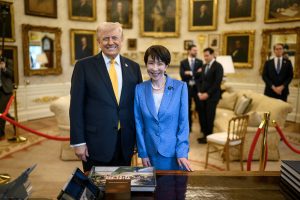
Among the Trump administration’s growing list of trade agreements, four stand out as especially significant – not just economically, but strategically. Deals with Japan, South Korea, Taiwan, and Indonesia represent a coordinated effort to strengthen U.S. ties with key regional powers that sit on China’s doorstep. Together, they form a geopolitical and economic counterweight to Beijing’s influence while still advancing core American interests.
This balancing act – strengthening alliances without sacrificing domestic industry – is a hallmark of President Trump’s trade strategy. These agreements are not charity. They are structured to drive investment into the United States, rebuild industrial capacity, and secure supply chains in critical sectors, all while reinforcing America’s position in the Indo-Pacific.
Broader economic indicators suggest that this approach is already having measurable effects. The most recent ISM Manufacturing PMI – a highly respected metric for measuring the health of the domestic manufacturing sector – was 52.7, its highest level since August 2022. A reading above 50 indicates expansion, while a reading below 50 signals contraction. Sustained readings above that threshold – now for three consecutive months – suggest growing momentum in the industrial sector.
Much of this shift has occurred with relatively little attention. Japanese media, for instance, has reported that tariffs and new investments in AI-related infrastructure have helped boost U.S. steel production, with output surpassing Japan’s for the first time in 26 years. Meanwhile, more than $1 trillion in private investment tied to these trade relationships is flowing into American production plants, shipyards, energy projects, and advanced manufacturing facilities.
Economists are beginning to take notice. Retired Professor of Economics Hideki Sakakihara described the transformation as “not just a leap in quality, but also in scale and efficiency,” likening it to “lifting a train from a worn, neglected track and setting it onto a sleek, magnetic path.”
Professor Ferdinand Senft, a former advisor to Bundesbank President Hans Tietmeyer, similarly characterized the moment as an “investment shock” – a surge in productive investment that lays the groundwork for long-term growth. “It is a jolt that revitalizes growth,” Senft said, adding that these deals could propel the U.S. economy “to new heights.”
The most substantial of the four agreements is with Japan, which has committed $550 billion in investment, loans, and guarantees for U.S.-based projects. Commerce Secretary Howard Lutnick highlighted major initiatives as part of this endeavor, including a 9.2-gigawatt gas plant in Ohio, a deepwater crude export hub in the Gulf of America, and a synthetic industrial diamonds facility in Georgia.
These projects are designed not only to create jobs, but to expand America’s industrial base and energy dominance. As Lutnick put it, “Japan is providing the capital. America gains strategic assets, expanded industrial capacity, and strengthened energy dominance.”
The partnership goes further. The two countries are coordinating supply chains for critical minerals, energy, and AI infrastructure. Japanese firms, including Asahi, Mitsui, Nippon Steel, Toshiba, Hitachi, and Mitsubishi, are positioning themselves to invest across sectors ranging from engineering to advanced research. Future projects may include nuclear energy development and expanded copper refining capacity, further reducing reliance on Chinese-controlled supply chains.
South Korea has followed a similar path. After passing new legislation, Seoul agreed to a $350 billion investment framework with the United States. The deal includes $150 billion for shipbuilding and $200 billion targeting emerging industries such as semiconductors, quantum computing, and energy.
Like Japan, South Korea is not simply investing abroad but is becoming an active player U.S. industrial ecosystem. This deepens economic ties while ensuring that key technologies and production capabilities are anchored in America rather than being offshored.
Taiwan’s agreement is perhaps the most strategically sensitive of all. With $250 billion in planned investment, matched by credit guarantees, the deal focuses heavily on semiconductor production – the backbone of modern technology and a critical vulnerability in U.S. supply chains.
Taiwan Semiconductor Manufacturing Company (TSMC) is expanding its Arizona operations, where its first U.S. plant opened in 2025. Under the new agreement, it plans to produce next-generation chips by the early 2030s. The deal also establishes import quotas and domestic production requirements to ensure that a significant share of output remains within the United States.
For the United States, the goal is a secure, reliable domestic supply of advanced chips while reducing dependence on foreign manufacturing – particularly in a region increasingly threatened by Chinese military pressure.
Finally, Indonesia rounds out this quartet of deals with a wide-ranging agreement that underscores its growing importance in global supply chains. Jakarta has committed to purchasing $4.5 billion in U.S. agricultural goods, $15 billion in energy, and $13.5 billion in aviation products, including 50 Boeing aircraft.
But the real strategic value lies in Indonesia’s natural resources. As one of the world’s leading producers of nickel, a key component in stainless steel and electric vehicle batteries, Indonesia occupies a critical position in the global minerals market. In recent years, China has sought to dominate this sector through aggressive investment and bilateral agreements.
The U.S.-Indonesia deal includes provisions allowing Washington to withdraw if Jakarta enters into competing arrangements that threaten American interests. This clause reflects a broader recognition that economic partnerships in this region are inseparable from strategic competition with China.
Taken together, these four agreements illustrate a coherent strategy of strengthening ties with key nations surrounding China, rebuilding domestic industry, and securing critical supply chains – all without compromising U.S. economic interests.
Rather than choosing between geopolitics and economics, the Trump administration is attempting to align them. These deals are not isolated transactions, but interconnected pillars of a broader effort to restore American industrial strength while countering Chinese influence.
It is a complex balancing act. But if early indicators are any guide, it is one that is beginning to pay off.
Ben Solis is the pen name of an international affairs journalist, historian, and researcher.
