
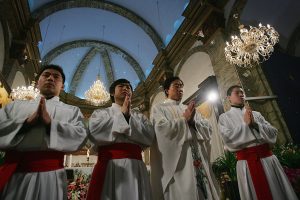
A shocking new report has shed fresh light on the ongoing abuses of Catholic believers inside communist China.
According to Human Rights Watch, Chinese authorities are intensifying pressure on underground Catholic communities to submit to the state-controlled official church, with Catholics facing tighter ideological control, surveillance, travel restrictions, and direct interference in religious life.
The extent of the persecution is appalling. Children are being barred from churches. Priests are being forced through political training. Religious teaching is being subjected to government review. Clergy have been ordered to surrender travel documents to party-controlled authorities. Some Catholics now avoid church altogether, praying in silence rather than risk being watched by the state.
Beijing calls this campaign “Sinicization.” But that word is a lie. The Chinese Communist Party is not trying to make Catholicism more Chinese. It is trying to make Catholicism more communist – that is, to destroy it entirely.
In Catholic history, missionaries have often sought to express the faith through local languages, customs, and cultural symbols. The Jesuits in China, for instance, translated Christian teaching into Mandarin, adopted Chinese dress, and drew on Confucian concepts to communicate the Gospel. That was a legitimate effort to bring eternal truth into conversation with Chinese civilization.
What Beijing is doing today is the opposite. It is not elevating Chinese culture inside the Church, but rather subordinating the Church to the Communist Party.
Dr. Huang Kun, who advised the CCP Standing Committee before defecting from China in the 1990s and later became Catholic, put it plainly: “This is not what the CCP does. They do not bring in national culture, but instead enforce party supremacy and ideology.”
In Dr. Kun’s view, terms like “Maoization” or “Sovietisation” better describe the campaign against China’s underground Catholics. The goal is not cultural harmony, but Leninist control. The party cannot tolerate an institution that teaches that God, not Xi Jinping, is the highest authority. Communism has always been the enemy of independent religion because communism demands total loyalty to the state. It seeks to replace the Church’s spiritual authority with the authority of the state.
That is why underground Catholics are such a threat to Beijing. They are not dissidents in the ordinary political sense. Rather, they are believers who refuse to pledge ultimate allegiance to the CCP.
The roots of this persecution go back to Mao. In 1950, the regime expelled the papal envoy and later imprisoned Cardinal Ignatius Kung of Shanghai, who spent decades behind bars for refusing to break with Rome. Priests and lay Catholics were tortured, killed, and driven into hiding. The result was China’s “church of silence,” a Catholic community forced into the shadows because it would not become an arm of the CCP.
Xi Jinping is now trying to finish what Mao began.
One senior priest who secretly serves underground Catholics told me in an interview that believers are being pushed to acknowledge the supremacy of the Party even before Mass and prayer. “Believers must publicly show before Mass and prayers that they acknowledge the party and Xi Jinping’s supremacy, even when turning to God,” he said. “This aims to diminish spiritual independence, so people rely on Xi, not God, whom the CCP refers to as a ‘primitive force.’”
That is the heart of the matter. Beijing wants Catholics to enter church already having declared that the CCP comes first. It wants priests who will preach only what the state approves. It wants bishops who are acceptable to the Party. It wants the Church reduced to another propaganda tool of the CCP.
The most troubling development is that the Vatican’s 2018 agreement with Beijing over the appointment of bishops appears to have made this pressure campaign easier. The agreement has helped authorities push underground Catholics into the official church. Its full text remains secret, and no pope has publicly exercised a veto over Beijing’s preferred bishop candidates, even after China violated the pact through unilateral appointments.
For underground Catholics, this creates a devastating moral and spiritual crisis. The Church they have suffered to remain loyal to appears, at least in their eyes, to be giving ground to the regime that has persecuted them.
A senior priest recalled that decades ago, when the Party unlawfully appointed a bishop and a CCP-approved Catholic group consecrated him without proper authority, the Vatican protested. More recently, after the agreement with the Holy See, Beijing selected a bishop again and the Vatican remained silent. To Catholics who have lost family members, livelihoods, freedom, and homes for refusing to place the Party above God, that silence cuts deeply.
The report describes Catholics forced into impossible choices. Either join the official church and risk betraying the faith, or refuse and face arrest, unemployment, surveillance, and isolation. One underground Catholic quoted by Human Rights Watch described the 2018 agreement as “the most intelligent weapon to legally destroy underground churches.”
Dr. Kun was even more direct about the nature of the campaign: “There is nothing Chinese in the CCP methods. It is only inhumanity, cruelty, and aggression toward the Chinese Catholic conscience.”
This is why the word “Sinicization” matters. It is camouflage that allows Beijing to present repression as cultural adaptation and CCP control as national identity. But beneath the language is the same communist instinct that has animated anti-religious persecution for more than a century.
“It is the CCP’s entire repulsive plan,” emphasized a former CCP propaganda official. “Now you understand why they are hiding behind the word Sinicization.”
The future Beijing wants is clear. It wants a Chinese Catholic Church that appears united with Rome but functions as a mouthpiece for the Communist Party. It wants Catholic clergy to praise the regime, suppress the suffering of underground believers, and teach that obedience to Xi is compatible with obedience to God.
But Catholic teaching cannot be reconciled with the party’s demand for total control. The Church may exist within nations, but it does not belong to any regime. It cannot proclaim Christ while treating the Communist Party as the final authority over conscience, worship, doctrine, and truth.
A historical parallel offers the right response. In 1953, when Poland’s communist regime tried to subordinate the Catholic Church, Cardinal Stefan Wyszynski answered with the famous phrase “non possumus” – we cannot. For China’s underground Catholics, that same answer may now be required again.
The question is whether the Vatican will say it with them.
Ben Solis is the pen name of an international affairs journalist, historian, and researcher.
