
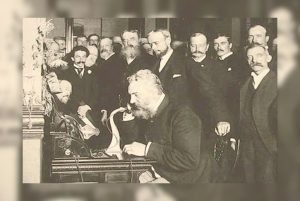
On March 10, 1876, a groundbreaking moment in the history of communication occurred when inventor Alexander Graham Bell successfully transmitted the first intelligible speech over a telephone. The brief message—“Mr. Watson, come here; I want you”—was spoken by Bell to his assistant, Thomas Watson, in another room of their Boston laboratory. Though simple, the words marked the birth of a technology that would revolutionize how people communicate across distances.
Bell had been experimenting with sound and electrical signals for several years before this historic breakthrough. Born in Edinburgh, Scotland, in 1847, he grew up in a family deeply involved in the study of speech and hearing. His father was an expert in speech correction, and Bell himself worked as a teacher of the deaf. These experiences fueled his interest in sound and communication, eventually leading him to explore ways to transmit human speech electronically.
During the early 1870s, Bell began working on a device known as a harmonic telegraph, which aimed to send multiple telegraph messages over a single wire simultaneously. While developing this technology, he became convinced that it might be possible to send not just coded signals, but the human voice itself over electrical wires. To help turn his ideas into reality, Bell partnered with Thomas Watson, a skilled machinist who assisted him in building experimental equipment.
The timing of Bell’s breakthrough was crucial. On March 7, 1876, he was granted a U.S. patent for his telephone design, securing legal ownership of both the device and the concept of a telephone system. Just three days later, the famous experiment took place in his Boston home laboratory. During the test, Bell accidentally spilled battery acid and urgently called out to Watson in the next room through the experimental transmitter. Watson clearly heard Bell’s voice through the receiver, marking the first successful transmission of spoken words by telephone.
The success of this experiment quickly drew attention from scientists and the public alike. Bell demonstrated the telephone later that year to the American Academy of Arts and Sciences and at the Centennial Exposition in Philadelphia. Soon afterward, further tests proved that the device could transmit speech over longer distances, confirming that it had enormous practical potential.
The telephone soon transformed communication, making it possible for people to speak instantly across cities, countries, and eventually continents. Bell went on to establish the Bell Telephone Company in 1877, which helped spread the technology across the United States and the world.
What began as a small laboratory experiment on March 10, 1876, ultimately changed daily life. Bell’s first transmitted sentence ushered in a new era of global communication—one that laid the foundation for the modern telecommunications systems that connect people around the world today.
